Launch Operations
Agreeing on responsibilities in a co-branded launch
Allocate product, stock, claims, checkout, customer support, IP and closeout duties before a co-branded offer opens for orders.

Desk
Focuses on unit economics, promotional strategy, fulfilment decisions and dashboards for founder-led teams.
Launch Operations
Allocate product, stock, claims, checkout, customer support, IP and closeout duties before a co-branded offer opens for orders.
Launch Operations
Prepare a short weekly trading pack, discuss material exceptions and leave with actions, owners and dates.
Unit Economics
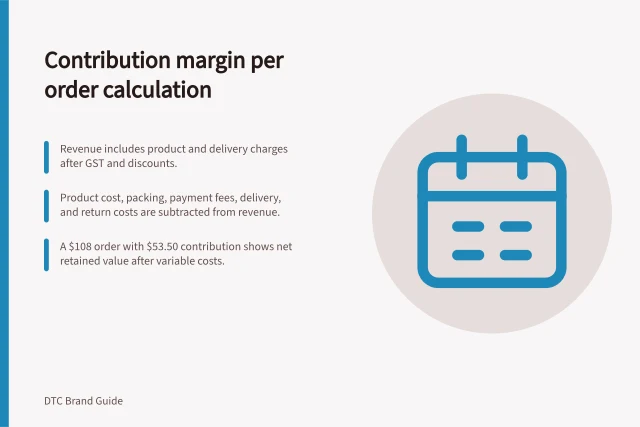
Calculate contribution per DTC order from retained revenue, product cost, payment, packing, delivery and returns, with a worked example.
Launch Operations
Decide whether to pack DTC orders in-house using dispatch capacity, stock accuracy, handling rules, full costs and clear review triggers.
Unit Economics
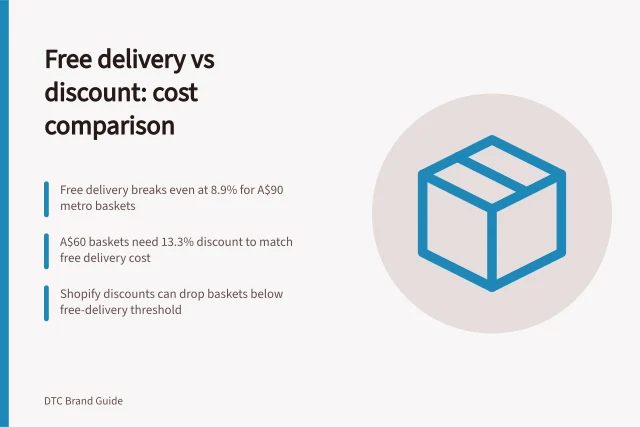
Free delivery and a percentage discount can have the same headline appeal but different cost by basket, destination and product margin.
Unit Economics
Compare wholesale and DTC contribution for the same item with consistent GST treatment, channel costs, displaced sales and payment timing.
Unit Economics
Reconcile rising DTC revenue with falling profit by checking order mix, discounts, serving costs, returns and new operating expenses.
Launch Operations
Compare in-house, partner and split fulfilment by customer promise, handling capacity, total cost and exception management.
Unit Economics
Build a DTC dashboard that connects orders, sellable stock, customer mix, returns and contribution to clear weekly decisions.
Unit Economics
Direct-to-consumer pricing should cover the economics of the product and make the value understandable without relying on a permanent sale.
Unit Economics
Understand DTC unit economics through order contribution, acquisition cost, repeat purchases, fixed costs and cash timing.
Launch Operations
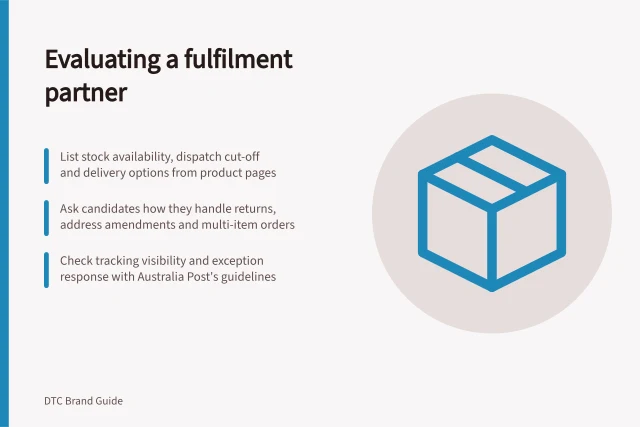
Assess a fulfilment partner using dispatch promises, packing rules, tracking events, exception ownership and complete operating costs.
Customer Feedback
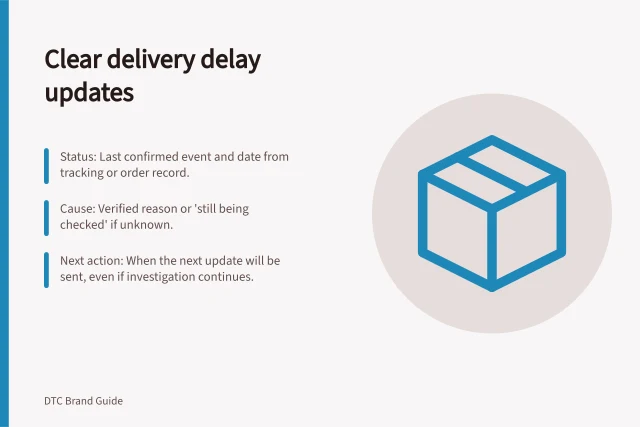
Give customers specific delivery-delay updates using verified order status, a next action, an update time and appropriate options.
Customer Feedback
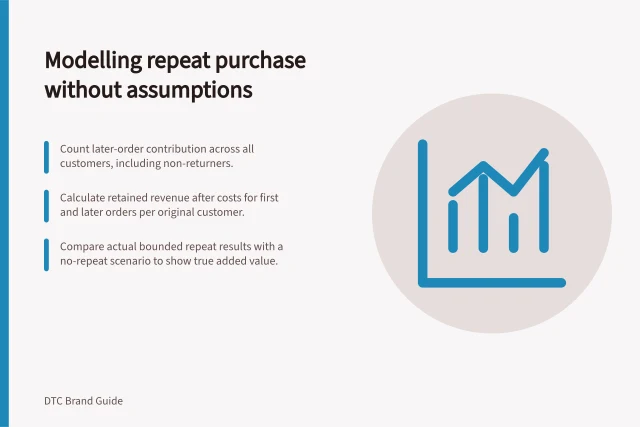
Build a repeat-purchase model from first-order cohorts, order contribution and a no-repeat case, with a hypothetical example.
Unit Economics
Compare orders, sellable stock, returns and contribution for the same variant before reordering or changing an offer.
Launch Operations
Set the quantity, audience, specification and review rule for a limited commercial release before considering a larger production run.
Unit Economics
Map inventory payments, sales receipts and slow-sales scenarios before committing cash to a larger DTC stock order.
Launch Operations
Specify protective packaging from product risks, carrier rules and finished parcel dimensions, then review damage reports and changes.
Unit Economics
Discount dependence appears when a brand must offer a code to achieve ordinary demand.
Customer Feedback
Classify revenue by each order's customer history, handle later refunds consistently and keep customer counts separate.
Unit Economics
Use first-order contribution and a chosen reserve to set a DTC acquisition cost ceiling, then check attribution and cash timing.
Launch Operations
Choose a pre-stock test that answers a specific DTC offer question, interpret each signal correctly and set a decision rule before committing cash.
Launch Operations
Plan a bounded DTC acquisition test, distinguish interest from first orders and decide what the results justify before increasing spend.
Unit Economics
Reconcile retained revenue, recovered stock value and order and return costs without counting a refund twice.