Unit Economics
Calculating contribution margin per order
Calculate contribution per DTC order from retained revenue, product cost, payment, packing, delivery and returns, with a worked example.

Section
Unit Economics
Calculate contribution per DTC order from retained revenue, product cost, payment, packing, delivery and returns, with a worked example.
Unit Economics
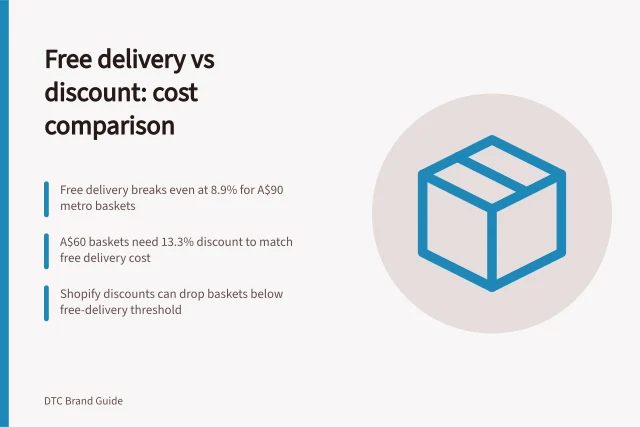
Free delivery and a percentage discount can have the same headline appeal but different cost by basket, destination and product margin.
Unit Economics
Compare wholesale and DTC contribution for the same item with consistent GST treatment, channel costs, displaced sales and payment timing.
Unit Economics
Reconcile rising DTC revenue with falling profit by checking order mix, discounts, serving costs, returns and new operating expenses.
Unit Economics
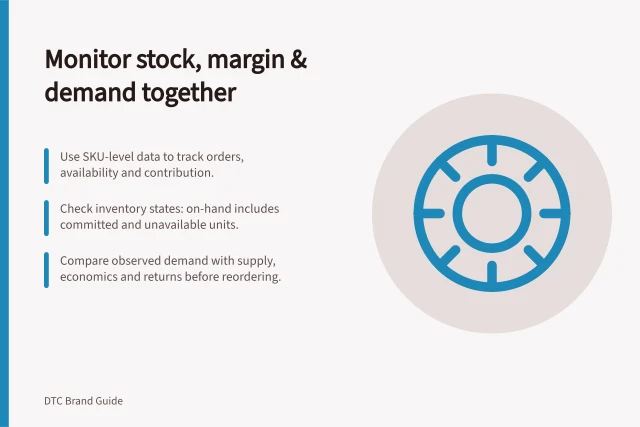
Build a DTC dashboard that connects orders, sellable stock, customer mix, returns and contribution to clear weekly decisions.
Unit Economics
Direct-to-consumer pricing should cover the economics of the product and make the value understandable without relying on a permanent sale.
Unit Economics
Understand DTC unit economics through order contribution, acquisition cost, repeat purchases, fixed costs and cash timing.
Unit Economics
Compare orders, sellable stock, returns and contribution for the same variant before reordering or changing an offer.
Unit Economics
Map inventory payments, sales receipts and slow-sales scenarios before committing cash to a larger DTC stock order.
Unit Economics
Discount dependence appears when a brand must offer a code to achieve ordinary demand.
Unit Economics
Use first-order contribution and a chosen reserve to set a DTC acquisition cost ceiling, then check attribution and cash timing.
Unit Economics
Reconcile retained revenue, recovered stock value and order and return costs without counting a refund twice.