Product Assortment
Part of DTC brand partnerships
Comparing a bundle partnership with a limited-edition collaboration
Compare a joint bundle with a distinct limited-edition product on customer benefit, stock risk, product work and operating commitments.
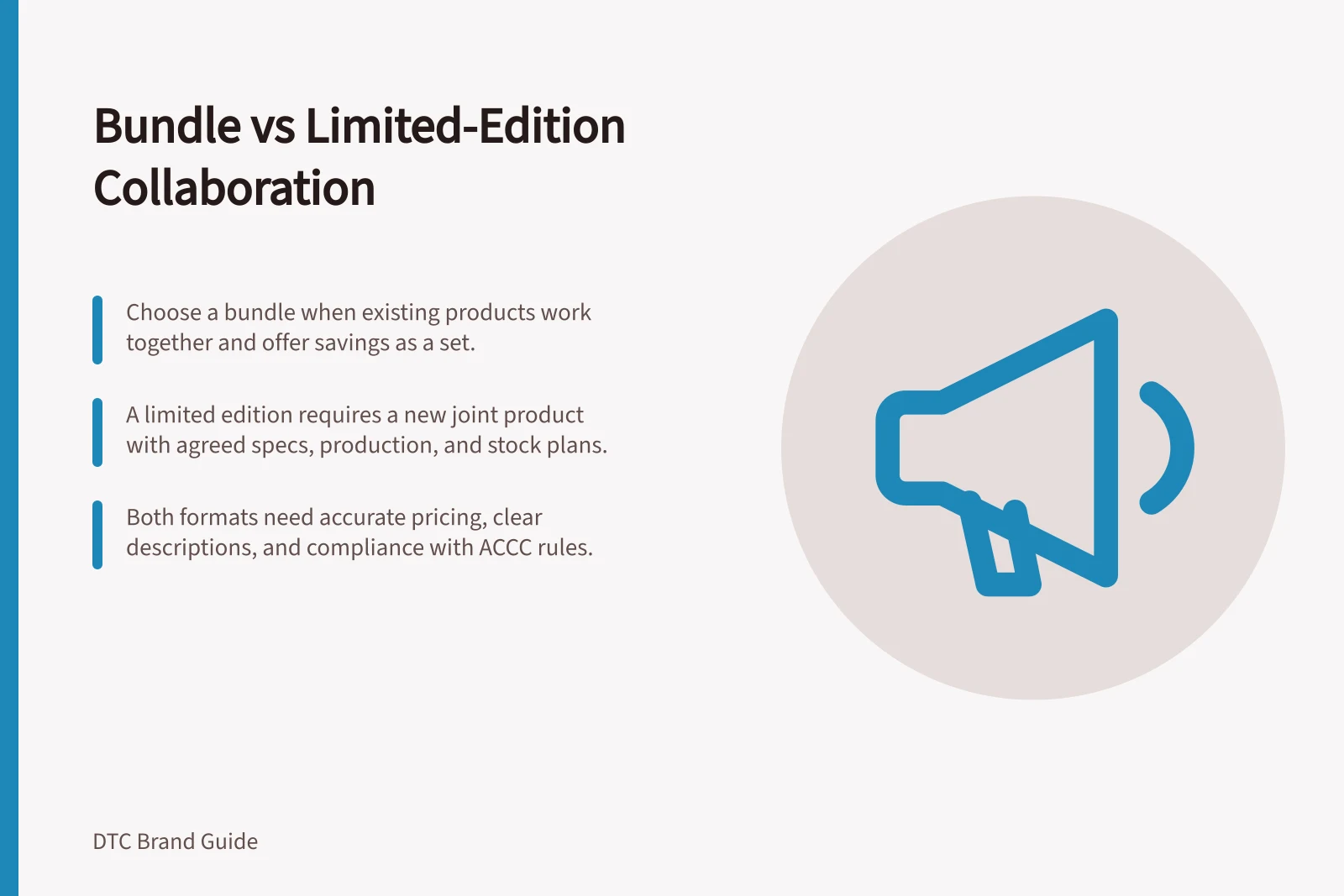
Choose a bundle partnership when two existing products already work together and the customer benefit lies in buying them as a set. Choose a distinct limited-edition collaboration when the benefit requires a new joint product or version and both brands can support its design, production and remaining stock. Neither format is inherently more valuable; the choice follows what the offer must do for the buyer.
Check what must change for the customer
In a bundle, each product remains identifiable. Confirm compatibility, exact contents, component stock, one clear offer and a reliable packing route.
A notebook and cover could form a useful set if the cover fits that notebook and the customer understands whether either item is sold separately. One box would not make an incompatible pair useful.
In this comparison, the limited-edition option is a jointly developed distinct product or version. The brands must agree a specification, approve samples, establish what differs and decide how many units to make. The difference should matter to the intended buyer.
A new colour or label may be a real distinction, but the page should not imply a new function if none was established. A limited run of an unchanged item is a different choice from developing a joint version.
Compare the commitments
| Decision | Bundle partnership | Distinct limited-edition collaboration |
|---|---|---|
| Product work | Verify how existing items work together | Develop and approve a distinct version |
| Stock risk | Account for each component across individual and set sales | Commit to production and plan for unsold units |
| Customer information | State contents, compatibility and any separate-item comparison accurately | State the version, difference and availability conditions accurately |
| Operating work | Coordinate picking, packing and component shortages | Add specification control, production checks and version-specific support |
| Review question | Did the set make an existing task easier to buy? | Did the distinct product justify its added commitment? |
A bundle may still need new packaging or a costly shared dispatch process. A limited run can be small, but a supplier minimum or special component can still tie up cash.
Price and describe either offer fairly
Calculate contribution using the actual price and relevant component, packing, payment, delivery and return costs. If the bundle advertises a saving against buying items separately, check that the comparison is accurate and can be supported. The ACCC says it can require businesses to back up claims they make about their products or services.
If a product is available briefly or in limited quantity, state the real conditions; do not invent scarcity.
Make the seller, contents, dispatch terms and help route plain. For a new joint version, check the actual goods against applicable Australian product safety or information requirements.
Both brands should approve material claims made using their names. A limited edition still needs evidence behind performance, environmental or other benefit claims.
ACCC Guidelines on Pricing and Claims
- Price Comparison Requirement
- Must be accurate and supportable
- Scarcity Claims
- Must reflect real conditions – no invented scarcity
- Product Safety Compliance
- Applies to all joint versions in Australia
- Brand Approval Required
- Both brands must approve claims using their names
Decide before ordering
Write the customer task, the minimum product change needed and the evidence still missing. If existing products solve the task, assess a bundle proposal for compatibility and order costs. If a new version is essential, use a development brief that names the difference, specification, ownership, supplier terms, order quantity and unsold-stock plan.
Choose neither format yet if the intended buyer’s benefit remains unclear. Interest in the collaboration is a reason to investigate, not a sales forecast.