Product Assortment
Part of Launching a direct-to-consumer brand
Choosing a focused first DTC product range
Decide which products and variants belong in a first DTC range by checking buyer fit, supply, costs and the work each stock line creates.
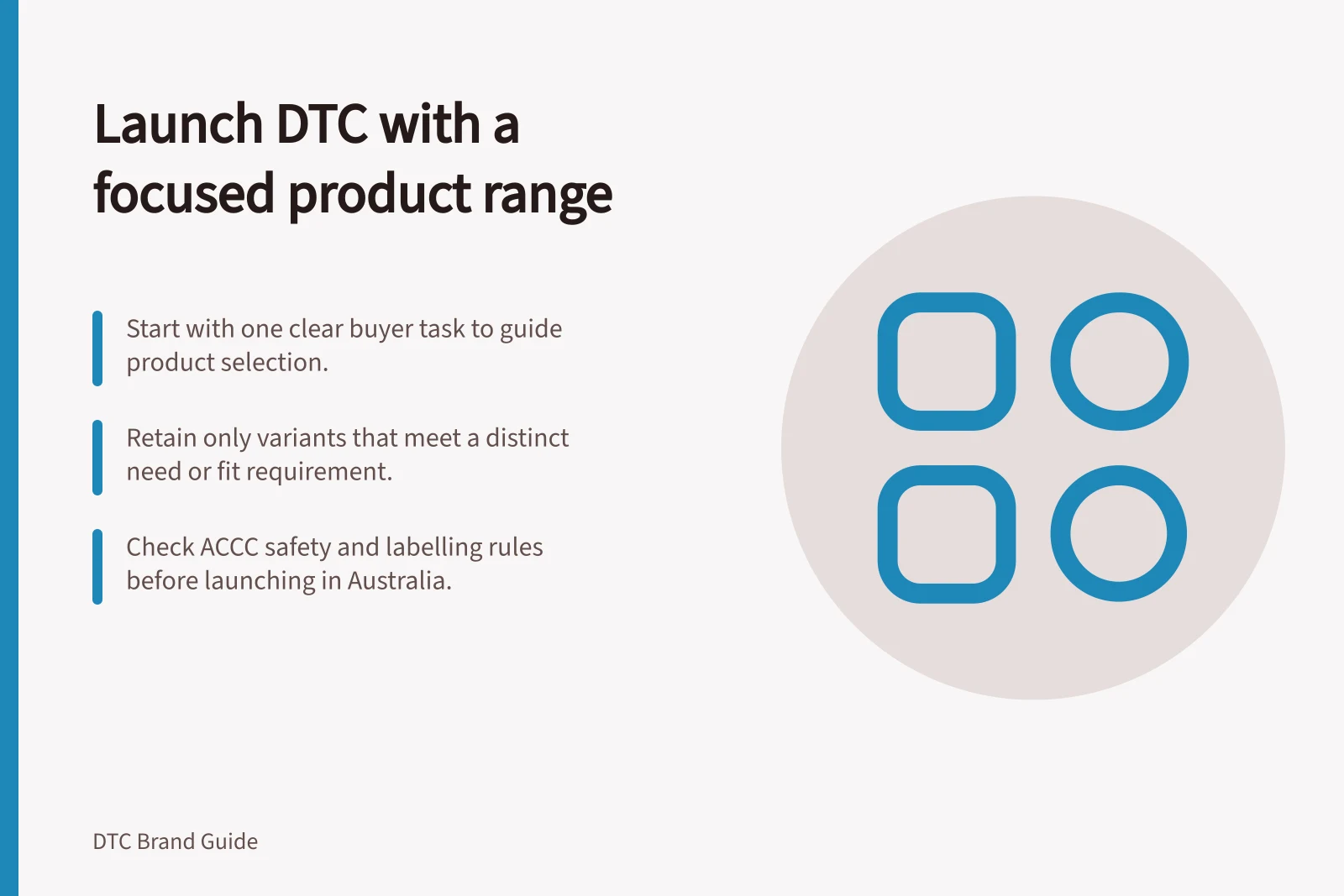
Choose a focused first DTC range by starting with one clear buyer task, then retaining only products and variants that meet a distinct need, fit requirement or required use. The right launch breadth is the smallest set that lets buyers complete that task without leaving a genuine need unmet.
Decide item by item and variant by variant, because every sellable version adds stock, supply and fulfilment work. Treat optional differences as candidates to defer, not as launch requirements.
Decide what the first purchase is for
Write the customer task at the top of the range plan. Ask what the buyer must choose to complete it.
A size difference may be essential if it changes fit, while two colours serving the same use may be optional at launch. If an accessory is needed to use the main item, decide whether it belongs in the box or needs separate explanation.
For example, retain a size variant when it changes fit, but defer an optional colour when two colours serve the same use. Include an accessory if it is needed to use the main item; otherwise, retain it only if it answers a distinct need or buying objection.
Compare candidates consistently
Use the same questions for every candidate:
| Question | What to establish before inclusion |
|---|---|
| Buyer fit | Which customer task or fit requirement does it serve? |
| Difference | Why would a buyer choose it over another item in this range? |
| Supply | Can the specification, sample and lead time be confirmed? |
| Economics | What are the likely product, packaging and order-handling costs? |
| Complexity | Does it need separate stock, instructions, content or packing rules? |
Treat supply and applicable compliance checks as gates: hold a candidate until its specification, sample and lead time are confirmed and its requirements are understood. Among viable candidates, retain those that serve a distinct buyer task, fit requirement or use; defer duplicates unless doing so leaves a genuine need unmet.
Count the work of a variant
Every sellable version needs an accurate description and stock record. Depending on the product and supplier, a variant may also mean a separate minimum order, packaging requirement, photograph, care instruction or returns question.
Give each sellable version a distinct product name or code. Inventory records can also include its description, quantity, supplier, cost and selling price.
Confirm which differences are physical and which are presentation only. Do not promise a choice that you cannot identify and dispatch correctly.
Consider a single-item order and a mixed order: can the range be picked, packed and explained consistently? This can expose unnecessary complexity, but the smallest catalogue is not always the right one if it leaves a genuine fit need unmet.
Key Considerations When Adding Variants to Your DTC Range
- Every variant requiresAccurate description, stock record, and unique product code
- Potential additional work per variantSeparate MOQ, packaging, photography, care instructions, or returns process
- Risk of misrepresentationPromising choices you cannot identify or dispatch correctly
- Critical test for consistencyCan the range be picked, packed and explained consistently for single and mixed orders?
Set a rule for the first order
For each retained item, record its approved specification, supplier terms, minimum order, lead time and proposed reorder trigger. Keep a demand estimate separate from the supplier minimum: a minimum order is a production constraint, not evidence that customers will buy that quantity.
Once trading starts, track sales and returns by item so a strong seller does not hide slow-moving stock elsewhere in the range.
Before ordering, use ACCC guidance to check whether a candidate has mandatory safety or information standards or is subject to a product ban. These requirements are law, and non-compliance can lead to penalties; general consumer product safety is shared between the ACCC and state and territory product safety regulators, with other agencies responsible for some product types.
Labelling requirements depend on the product. Under Australian Consumer Law, country-of-origin claims must be accurate and truthful; false or misleading claims can lead to penalties, and most retail food products sold in Australia need a country-of-origin label.
The Food Standards Code sets out further food label information, including use-by and best-before dates, ingredients, allergens and nutrition information. Pre-packaged goods must follow trade measurement laws for the position, size and format of measurement information, and goods packed in Australia must show the packer’s name and address.
Record what is included, why each item exists and what was deferred. The first range can change when sales and customer feedback provide better evidence.