Brand Positioning
Part of DTC brand positioning
Comparing category conventions with a distinctive brand angle
Audit competing offers, preserve details buyers need and select a distinctive brand angle that your product can support.
Separate information buyers need from messages many brands repeat when comparing category conventions. Keep the useful conventions, then choose an angle that matters in a real purchase and that the product can deliver. A distinctive look should still leave the offer easy to understand.
Define the set a buyer would compare
Start with a purchase situation and a shortlist of direct competitors, substitute products and the option of doing nothing. Compare offers a buyer could plausibly choose, using the same intended use and market where possible. Record when each page or offer was viewed; prices, stock and copy can change.
For each alternative, note the headline promise, visible specifications, images, service terms and limits. Record whether a point is a product feature, a claim or a style choice. An unanswered question on one page is not proof that the competing product lacks a feature.
Mark what is expected and what is overused
A compact audit can show where differentiation may help:
| Observation | What to ask | Possible response |
|---|---|---|
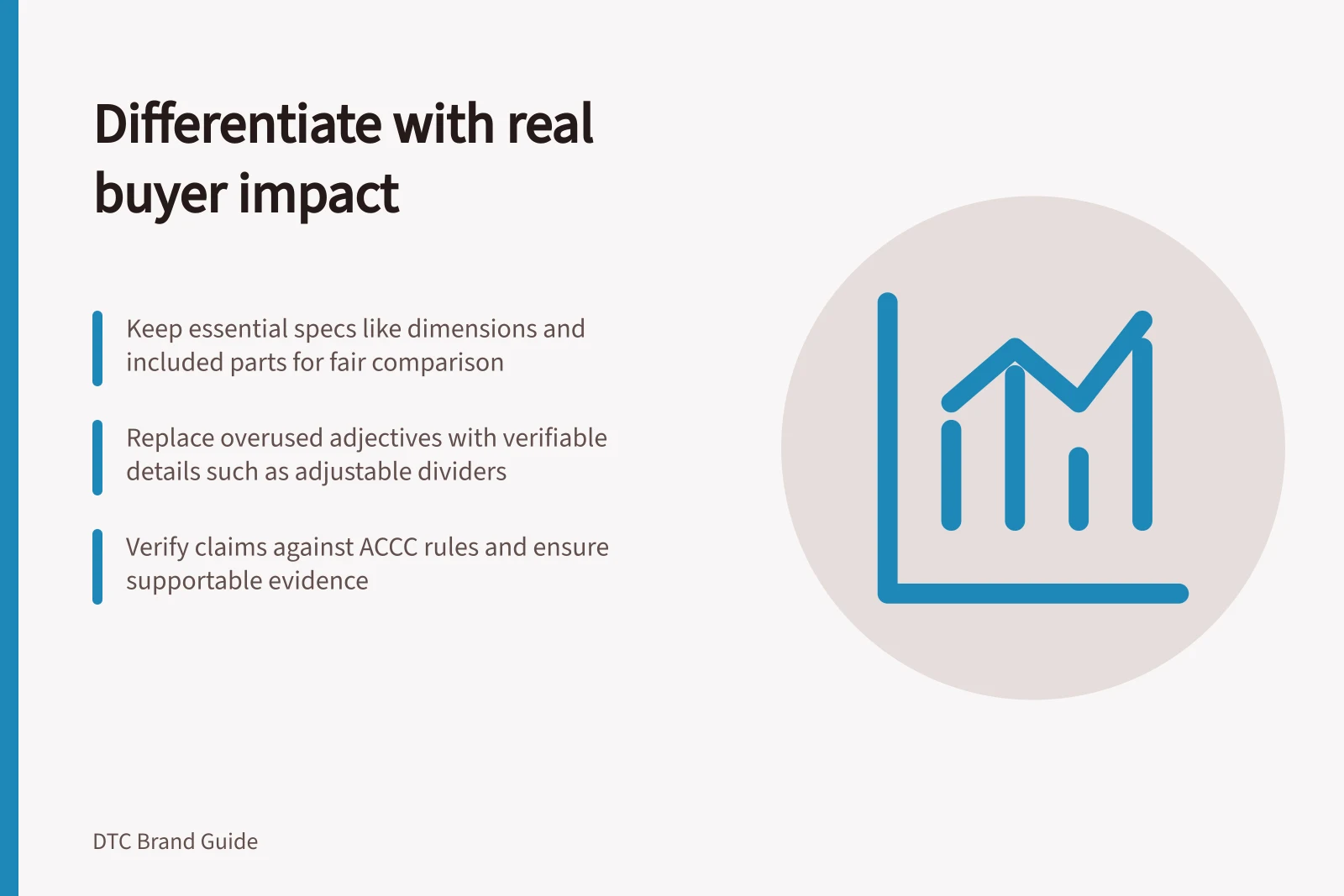
| Buyers need a detail to judge fit | Would removing it make the purchase harder? | Keep it prominent and accurate. |
| Many brands use the same broad adjective | What fact does the adjective communicate? | Replace it with a supportable detail. |
| A concern appears in customer accounts but is poorly answered | Does our product address it? | Investigate it as a possible angle. |
| A competitor appears to make a strong claim | Can we compare equivalent products fairly? | Verify both sides before any public comparison. |
For a hypothetical desk organiser, dimensions and included parts might be category basics. An explanation of adjustable dividers could be an angle if the finished item has them and intended buyers care about arranging their supplies. The audit alone would not establish that this is a winning position.
Choose an angle with a buyer consequence
Write each candidate as difference → use consequence → support → limit. Reject a candidate if buyers have no reason to value the difference, the consequence is speculative, or the product cannot support it. An angle may also be a service choice, such as replacement-part availability, if the business can provide it as described.
Check the angle against the rest of the offer. A “simple to choose” position should survive the variant selector and product page. A “compact” position needs dimensions relevant to the intended use.
A premium angle needs a reason for its higher price; price alone does not establish value. Australian business guidance recommends comparing competitors on features, quality and customer service as well as price.
Compare fairly in public copy
An internal comparison table helps the team decide. A customer-facing superiority claim should have a fair basis, current information and clear conditions. The ACCC says it can require businesses to back up claims they make about their products or services. If the evidence is incomplete, explain your own verified feature without claiming that competitors lack it.
Review the chosen angle after seeing how buyers interpret it. Keep the conventions that help them decide, revise wording they misunderstand and drop a distinction the product cannot support.