Customer Feedback
Part of DTC product development
Testing a prototype with intended buyers
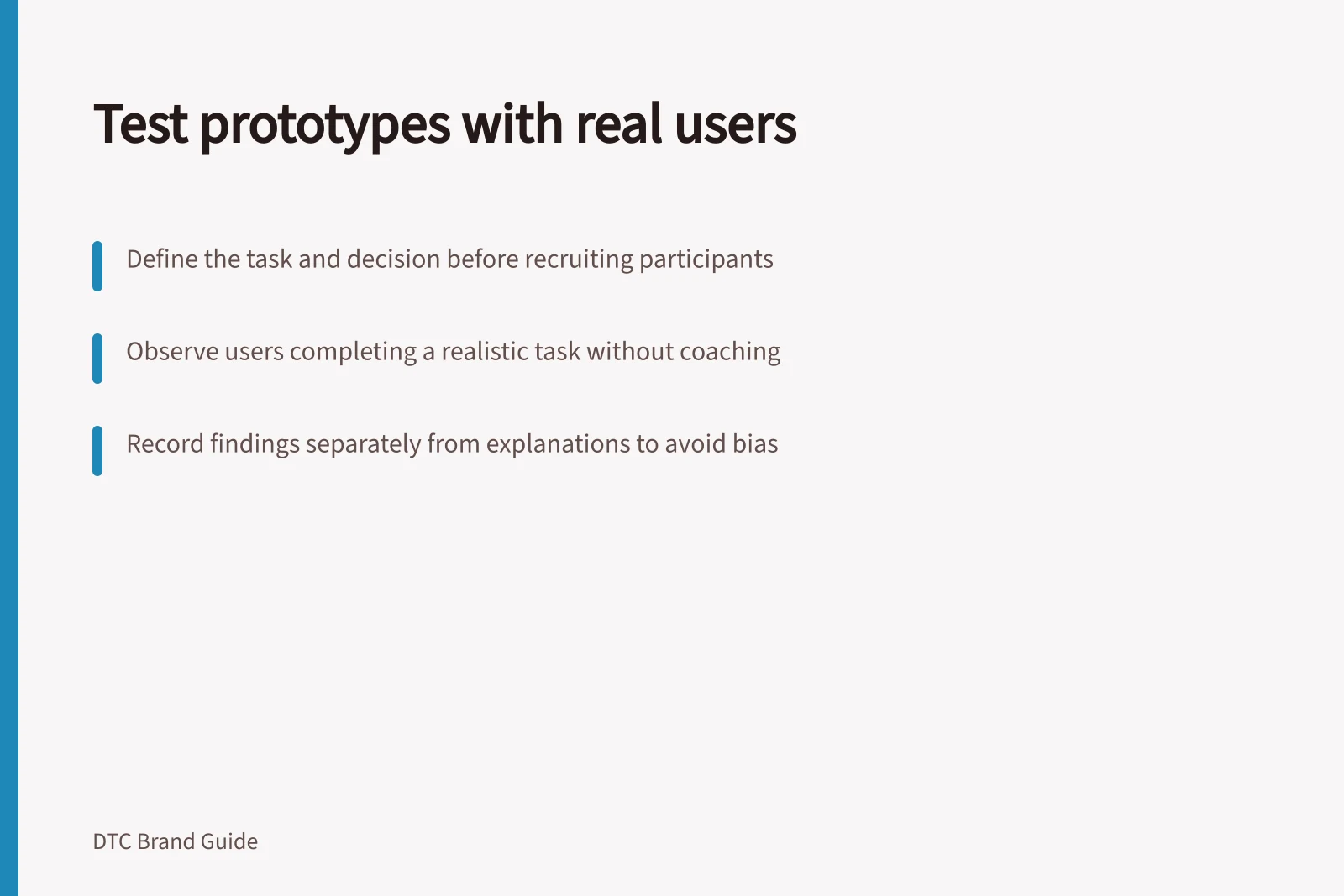
Plan a prototype session: set a realistic task, observe intended buyers and separate use findings from safety and demand claims.
Test a prototype by giving intended buyers a realistic task, observing what they do and deciding what the result says about the design. Define that decision before recruiting. Approval of a sample is neither a product safety assessment nor proof of purchase demand.
Key Facts About Prototype Testing in Australia
- No safety assurance from testingObserving a prototype does not prove compliance with Australian product safety standards.
- Approval ≠ market demandUser approval of a sample is not proof of purchase intent or commercial viability.
- Design revisions require retestingA materially revised version must be tested again to validate improvements.
Choose the uncertainty
Write down the intended use, the feature being assessed and an observation that would prompt revision. For a hypothetical storage pouch, the question might be whether someone can put their usual items inside and retrieve one without emptying it.
Record the sample's dimensions, contents and version. If its material or construction differs from the intended product, findings about feel or durability may not transfer.
Prepare a task resembling normal use. Let participants see the instructions or description a buyer would receive. Avoid explaining the intended method before they try, unless guidance is needed for safe handling.
Recruit for the intended use
Invite people who face the situation, including some who use a competing or improvised solution. Record how each person was recruited.
Friends may reveal unclear instructions, but their approval is a weak basis for claims about intended buyers. Do not describe a small, selectively recruited group as representative of the Australian market.
Assess foreseeable hazards before inviting anyone to handle a sample. Check whether standards or bans are relevant to the proposed goods. Observing a person use a prototype does not establish the safety or compliance of future production units.
Observe, then ask
Give participants the same core task without coaching. Note pauses, unexpected use, requests for help and failures.
Keep what happened separate from your explanation of why. Afterwards, ask what they expected, what was difficult, what they use now and whether they would accept any trade-off introduced by the design.
Ask for a concrete comparison with a recent use rather than whether they love the concept. Someone may like a feature and still prefer an existing product.
Decide what to change
Group observations by the design element involved. Repeated difficulties may call for revision; one serious failure can matter, particularly where safe use is affected. Check whether a problem arose from unfinished sample construction, the instructions or the intended design.
Record the sample version, task, participant criteria, observed difficulties, change decided and remaining uncertainty. Test a materially revised version again. A buyer-use session and a product safety assessment answer different questions; report each only for what it establishes.