Customer Feedback
Part of DTC growth decisions
Choosing between more traffic and a better product experience
Locate where DTC buyers hesitate, then choose whether to invest in more relevant traffic or improve the offer they encounter.
Invest in more traffic when suitable visitors can understand and buy the current offer on workable terms. Improve the product or buying experience first if repeated questions, use problems or returns show that more visitors would meet the same obstacle. A low conversion rate alone cannot tell you which investment is right.
Find where buyers hesitate
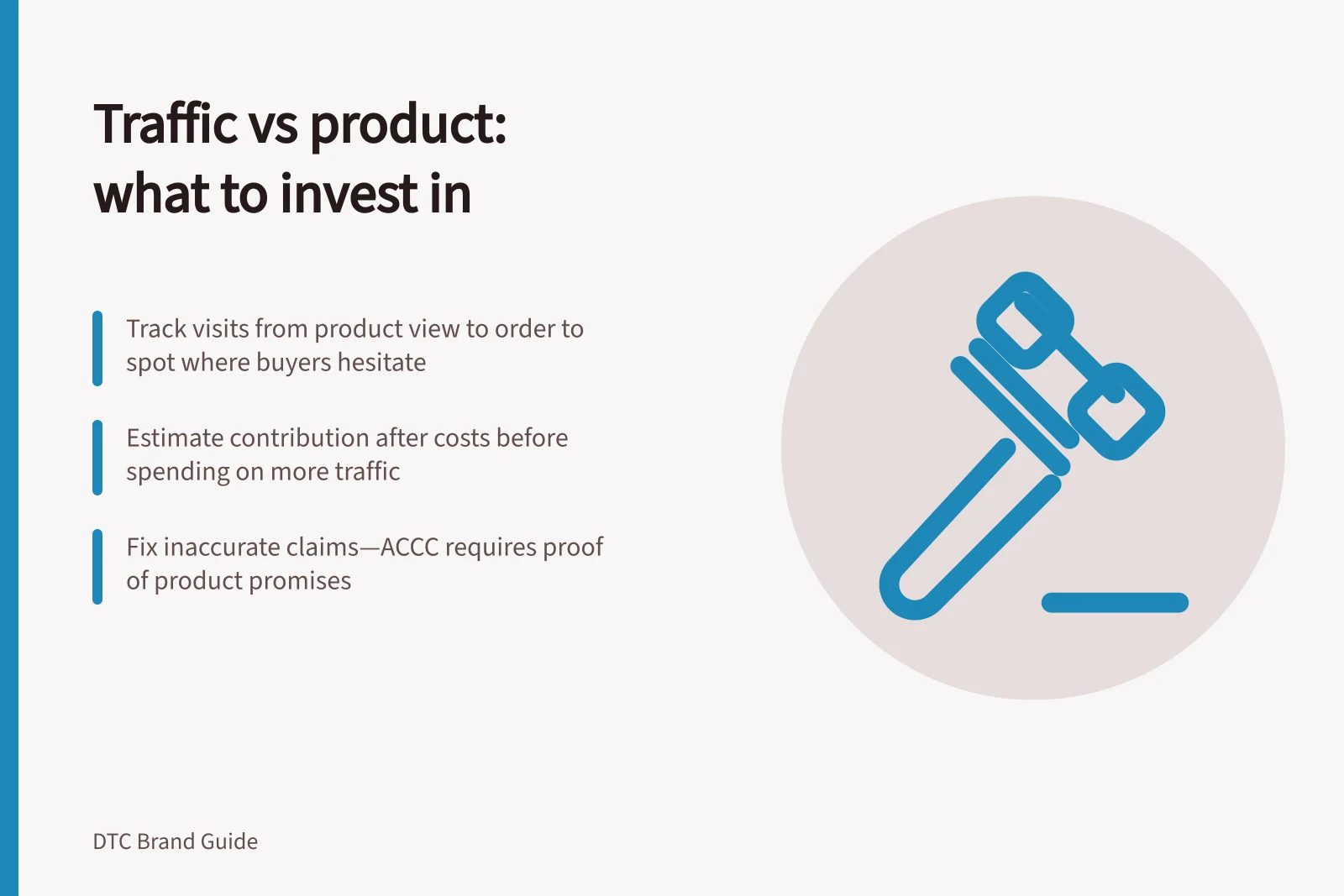
Track a defined group of visits through product viewing, variant choice, checkout and completed orders. Separate traffic sources and offers. Record stockouts, price changes and delivery restrictions, which can distort a comparison.
Read customer accounts alongside the numbers. Repeated questions about contents or fit may point to missing information, a difficult choice or the product itself. Leaving after the delivery charge appears may point to the offer's terms. Buying and then reporting that the item differs from expectations may call for a product change, a description change or both.
| Observation | First check | Possible next investment |
|---|---|---|
| Few suitable visitors reach the offer | Audience, message and route | A bounded traffic test |
| Suitable visitors ask the same purchase question | Product facts and where they appear | A clearer page or choice aid |
| Relevant complaints or returns follow orders | Product version, claims and use conditions | Correct the product or expectation |
| An offer works for a small audience | Contribution, stock and service capacity | Carefully extend its reach |
These observations suggest questions to investigate; none proves a cause.
Compare what the next spend could achieve
Estimate contribution from an additional suitable order after discounts, product and order costs, and expected returns. Compare that with the cost of reaching more buyers. Treat an experience change as an investment: design work, samples, content and any changed product cost belong in its case. It may be valuable if it reduces mismatched purchases even without an immediate rise in conversion; check the result after release.
Do not justify traffic spend with repeat purchases that comparable customers have not made. Do not call a page change successful because the team likes the new wording.
Make one bounded check
Write down the suspected obstacle, the evidence for it and what result would change the decision.
For a traffic question, keep the offer reasonably steady while testing a relevant audience within a spending limit. For an experience question, change the smallest part that addresses the identified obstacle. Review eligible orders, retained contribution, buyer questions and returns over a period suited to those outcomes.
Audience mix, seasonality and stock can affect a small comparison, so record those limits. If a product or delivery promise is inaccurate, correct it before promoting the offer. The ACCC can require businesses to back up claims they make about their products or services.
Key Metrics to Monitor After a Test
- Eligible Orders
- Number of completed orders meeting criteria
- Retained Contribution
- Profit after costs and expected returns
- Buyer Questions
- Frequency of repeat inquiries post-test
- Returns Rate
- Percentage of orders returned due to mismatched expectations