Launch Operations
Part of DTC growth decisions
Assessing readiness for a second country
Assess buyer demand, product requirements, delivery, contribution and cash before testing a second country.
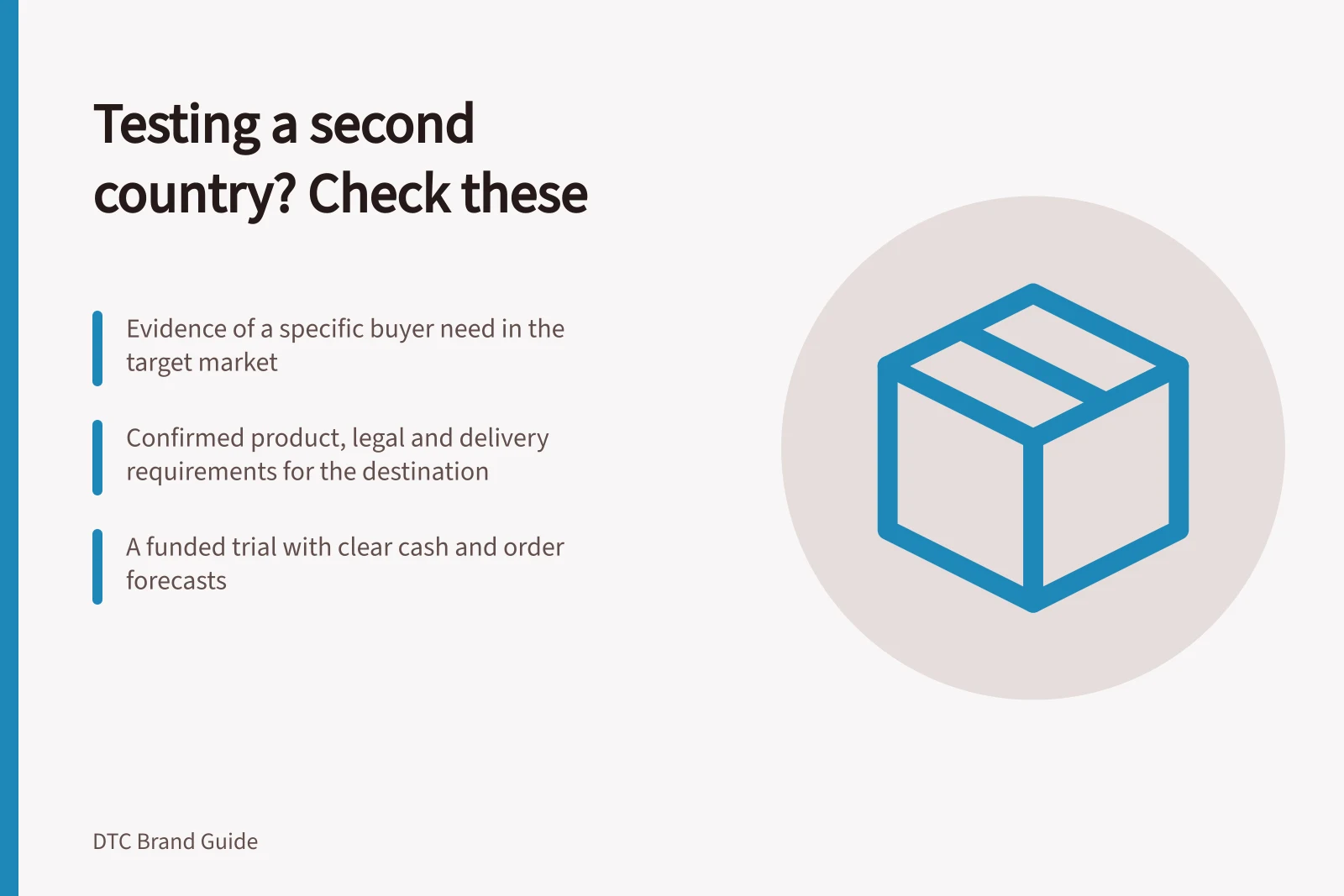
An Australian DTC brand is ready to test a second country when it has evidence of a specific buyer need. It has also checked the requirements for its exact goods and destination, can describe a supportable delivered offer, and can fund the trial without weakening existing orders. Visits from overseas are a lead to investigate, not proof of repeatable demand.
Choose one destination and offer
Start with a product and buyer situation that work in Australia. Investigate what buyers in the proposed destination use for the same task, what they need to know before ordering and why they might choose an imported item. Speak with potential buyers where possible and compare local alternatives. Overseas visits or enquiries do not establish acceptance of a local price, delivery time or returns arrangement.
Define the first offer: product version, destination, displayed currency, delivery route and support contact. A general 'ships worldwide' statement leaves important buying terms unresolved.
Steps to test a second country
- Start with a product and buyer situation that work in Australia
- Investigate local alternatives and buyer needs in the target market
- Define the first offerproduct version, destination, currency, delivery route, support contact
- Check export and import rules for the product and destination
- Get a quote for packed item and delivery address
- Rebuild order and cash case with destination-specific pricing
- Record trial dataaudience, orders, cancellations, questions, exceptions
Check requirements and delivery
Identify the Australian export and destination-country rules for the actual product before taking orders. Product standards, labels, customs documents, intellectual-property and tax obligations can depend on the goods and market. Australian Government guidance says exporters must consider laws and requirements in both places. This article cannot clear an unnamed product for an unnamed destination.
Get a quote for the packed item and delivery address. Establish who pays any entry charges, how the buyer will learn about them, and what happens when a parcel is delayed, undeliverable, faulty or returned. Check the chosen carrier's service terms. Do not present an estimated transit time as a guaranteed arrival date without grounds for that promise.
Rebuild the order and cash case
Use a destination-specific price and the revenue the business expects to retain. Include product, packaging, payment and currency charges, freight, support, and likely return or replacement costs. Keep tax, duty and registration assumptions visible until the actual arrangement has been checked. State the exchange-rate assumption used for planning.
Forecast cash as well as order contribution. Stock, content, advice or fulfilment changes may need payment before enough destination orders arrive. Include a slow-sales case; an Australian basket does not establish the economics of an international one.
Key considerations before testing a second country
- Destination-specific price
- Include all costs: freight, support, returns, tax, duty
- Exchange-rate assumption
- State clearly for planning purposes
- Cash forecast
- Include slow-sales scenario; not based on Australian basket
- Payment timing
- Stock or content changes may require upfront payment
Decide whether to test
Record four answers: buyer and alternative; product and legal requirements; delivered customer promise; contribution and cash exposure. Mark each confirmed, assumed or unresolved. Hold the affected offer while a material requirement or promise remains unresolved.
If the case is credible, define a limited offer and review point. Record the audience, product version, terms, orders, cancellations, questions, delivery exceptions and retained contribution. A small trial can reveal operating issues; it cannot establish demand across a country.
Assess readiness for a second country
- Buyer and alternativeConfirmed, Assumed, or Unresolved
- Product and legal requirementsConfirmed, Assumed, or Unresolved
- Delivered customer promiseConfirmed, Assumed, or Unresolved
- Contribution and cash exposureConfirmed, Assumed, or Unresolved