Launch Operations
Part of DTC wholesale and retail expansion
Avoiding channel conflict after a wholesale launch
Manage product information, stock, promotions and customer issues across a DTC store and Australian retail stockists after launch.
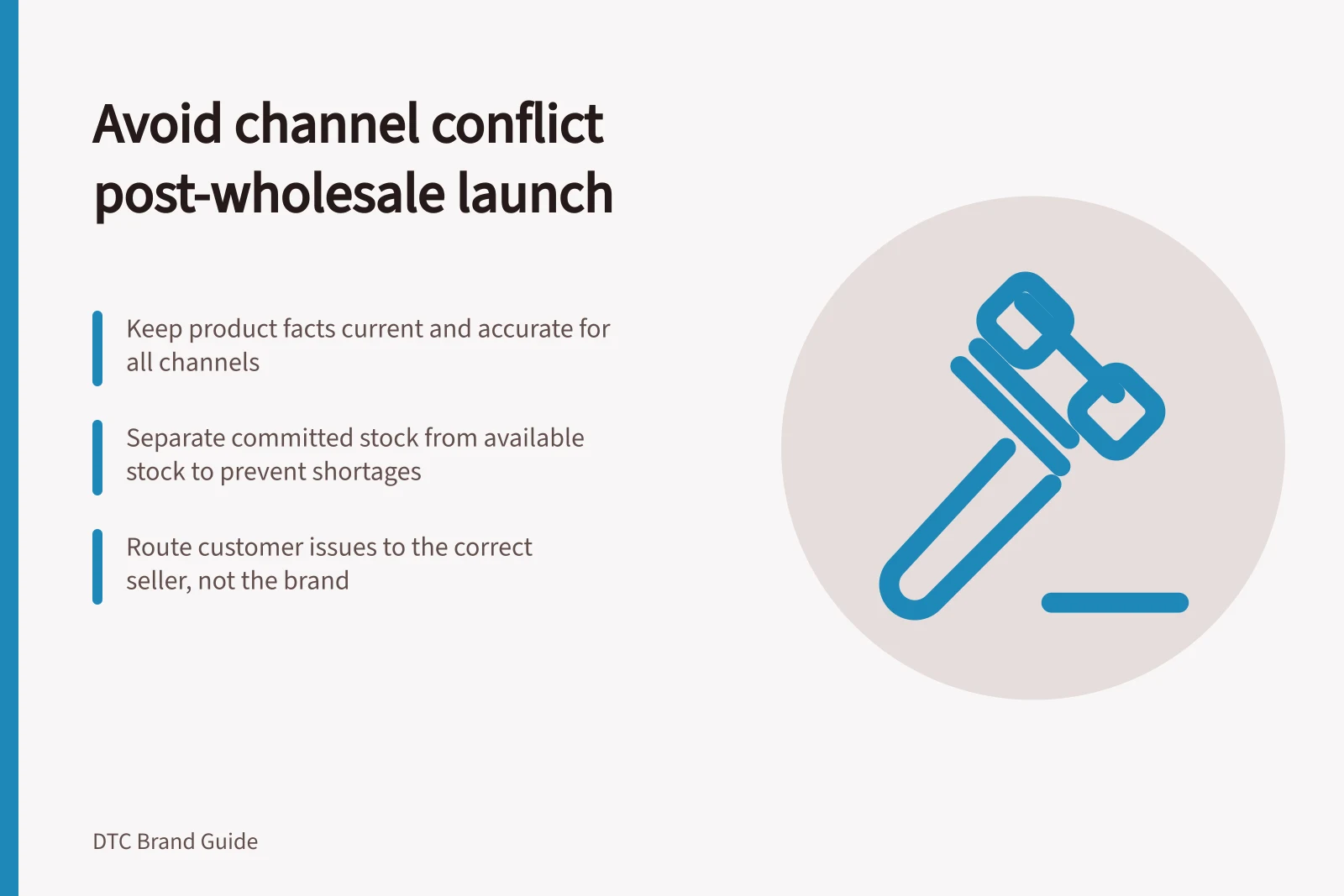
After a wholesale launch, prevent avoidable friction by keeping product facts current, separating stock commitments, coordinating offers and routing customer issues to the seller. The Australian Competition and Consumer Commission (ACCC) provides information on competition and consumer law, investigates potentially illegal anti-competitive behaviour and can take action; it does not intervene directly in business disputes.
Under Australian competition law, suppliers cannot prevent or attempt to prevent resellers from advertising or selling below a specified minimum price. A recommended resale price (RRP) must remain voluntary, while the brand can set its own direct-store price.
Record what each channel sells
Keep a current channel map for shared SKUs: product version, included parts, packaging, availability and customer-facing claims. Give stockists updated facts and a route for reporting an old image, material or size.
If the direct store offers an exclusive bundle or service, describe its real difference accurately. Do not label the same item as a different version merely to obscure a price comparison.
Agree how product and packaging revisions will reach retailers, including what the brand can submit and review on a retailer-owned listing. Do not assume the brand can edit the page directly.
Keep listing, packaging and advertising claims accurate and supportable. The ACCC can require businesses to back up claims and may investigate misleading claims.
Treat stock as a shared commitment
Separate units promised to direct customers, accepted retailer orders and stock still available to allocate. This makes clear which stock is committed and which remains available.
A retailer forecast is not a confirmed purchase order. An incoming production run is not available stock.
Before a direct promotion or new retail allocation, check quantities and replenishment lead time. Record the latest production and availability information for both channels.
Before a shortage occurs, agree and record an allocation rule for available stock. Base the rule on commitments already made, including accepted retailer orders and direct-customer promises, and apply it consistently.
When a shortage occurs, tell each affected party what is confirmed, what is delayed and when the next update will come. Do not describe a forecast or production run as confirmed stock.
Record which product version each channel has so support can answer questions about the item a shopper bought. Update that record when a version changes.
Handling a Stock Shortage Across Channels
- Identify committed stockDirect customer promises and accepted retailer orders
- Confirm available stockOnly units not yet committed or allocated
- Apply pre-agreed allocation ruleBased on existing commitments and lead times
- Communicate updates clearlyWhat’s confirmed, delayed, and next update date
- Record product version per channelFor accurate support and issue resolution
Plan promotions without a resale-price floor
A brand can choose its direct-store price and may give retailers an RRP. Keep that recommendation voluntary; the retailer decides its resale price.
Australian competition law prohibits suppliers from preventing or attempting to prevent resellers from selling below a specified minimum price. Do not make supply conditional on a retailer maintaining a price or threaten to change or stop supply because it discounts.
The ACCC reported that Hard Rock admitted requiring certain resellers to sell within a specific price range between 20 June and 11 September 2024. Hard Rock told ten resellers not to sell below 10 per cent of its RRP and warned it might adjust pricing or cease supply.
Before a direct promotion, check available stock and tell stockists its timing and product scope. If the activity is joint, make clear who funds the offer and what was agreed.
If a retail discount causes tension, establish who funded the offer and what was agreed about joint activity. Discuss future range, timing or voluntary campaigns without asking the retailer to maintain a minimum selling price.
Keep advertised savings in the brand's own channel accurate and based on reasonable grounds. Retain information that supports the claim.
Direct Store vs Retail Channel: Key Differences in Pricing and Promotions
- Brand's Direct-Store Price
- Set by the brand; no restrictions on discounting
- Retailer's Resale Price
- Decided by retailer; must not be restricted by supplier
- Recommended Resale Price (RRP)
- Voluntary recommendation only; not enforceable
- Supplier Pressure on Pricing
- Prohibited under Australian competition law
Route customer problems without delay
Tell shoppers how to contact the seller from whom they bought. Record whether the purchase was direct or retail so the issue reaches the right seller.
When a customer contacts the brand about a retail purchase, help connect them with the retailer and provide relevant product information. Agree how the retailer can escalate a suspected fault or safety concern to the brand.
Under the Australian Consumer Law, consumer guarantees are separate from warranties offered by a business and cannot be taken away by anything a business says or does. Do not suggest that a warranty or a notification deadline removes those rights.
The ACCC reported that Hard Rock admitted displaying deadlines of 7 business days for faulty or incorrect goods, 48 hours for delivery shortages or incorrect products, and 7 days for faulty products. The ACCC said the representations were false or misleading because they sought to restrict consumer-guarantee rights.
Review repeated questions and returns by product version and channel. A count alone does not prove a product defect or identify which business caused the problem.
If shoppers misunderstand a feature, inspect the listing and packaging they saw. Use the agreed route to request a correction from the retailer where its listing needs updating.
Consumer Guarantee Rights Under Australian Consumer Law
- Right to Repair, Replace or Refund
- Guaranteed regardless of warranty terms
- No Time Limit for Faults
- Can claim within a reasonable time after purchase
- False Claims About Deadlines
- Hard Rock admitted misleading claims about 7-day deadlines
Review the relationship on evidence
Set an agreed review interval and record its next date; revisit earlier after a stock delay, promotion or repeated customer issue. Compare confirmed orders, available stock, retailer reorders, direct contribution, customer issues and the cost of servicing the account.
Ask for shopper-sales or sell-through information the retailer is willing and able to provide. Agree what information it will share and when; units shipped to a retailer do not show sell-through.
Give each unresolved conflict an owner, next action and follow-up date. The ACCC does not intervene directly in disputes between businesses.