Unit Economics
Part of DTC growth decisions
Planning cash needs before scaling inventory
Map inventory payments, sales receipts and slow-sales scenarios before committing cash to a larger DTC stock order.
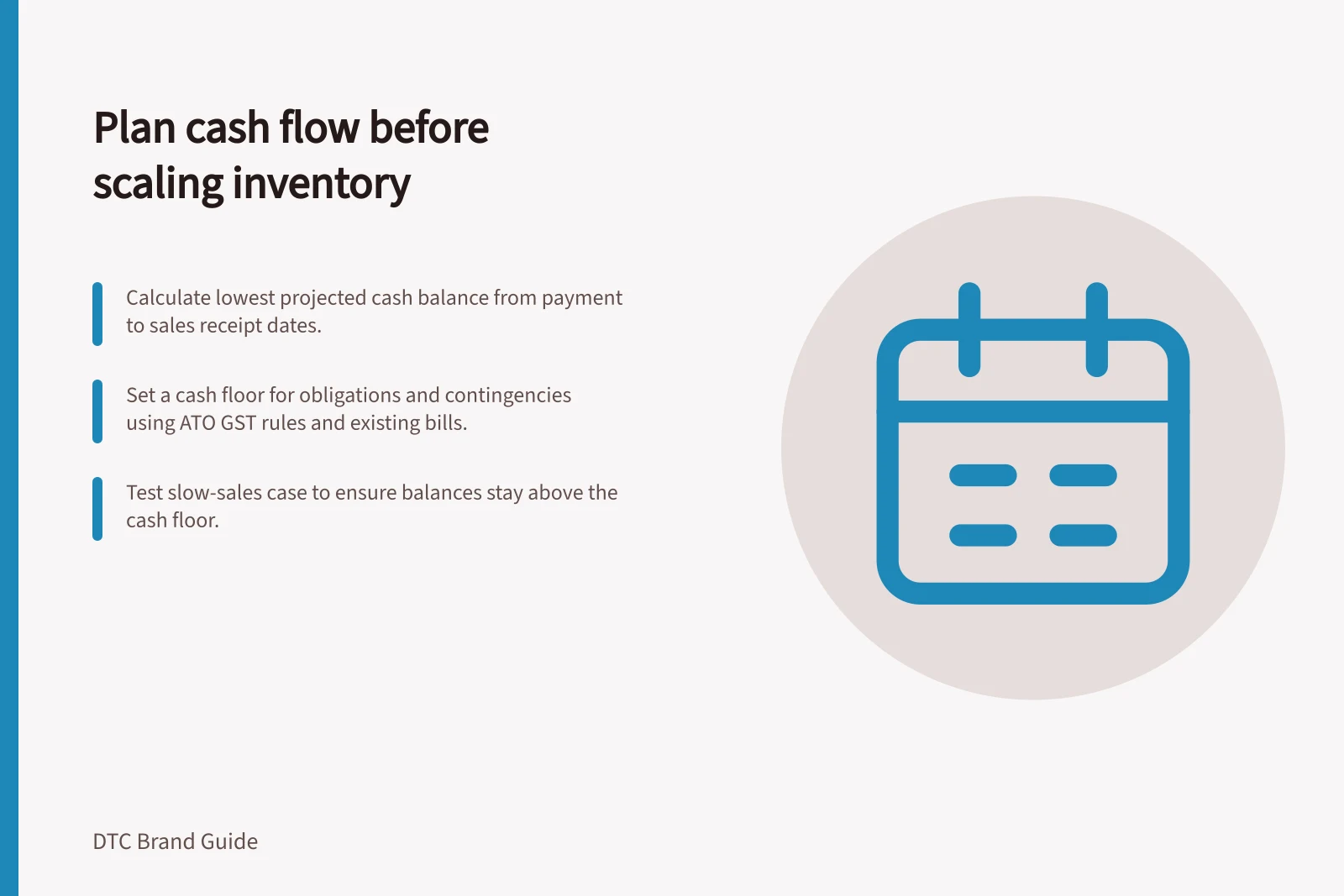
Before increasing an inventory order, map when its payments leave the business and when sales cash may return. Calculate the lowest projected cash balance from the order payment dates through the expected sales receipts, then compare it with a cash floor for existing obligations and contingencies. Test a slow-sales case before deciding how much stock the business can fund.
Define the stock commitment
List each proposed SKU and quantity, specification, supplier price, order multiple and quoted payment terms. Add deposits, balance payments, freight, receipt checks, storage and packaging for the larger run. Total the payments on their expected dates: a quoted unit price is only part of the cash commitment.
Separate sellable units from stock committed to customers, incoming units and items awaiting inspection. Review demand for each variant while it was available, and use expected production, delivery and inspection dates to plan when stock could sell. For each payment, count the time until related sales cash arrives; payments made before those receipts create the cash-timing gap.
Cash Flow Timeline for Inventory Commitment
Forecast each period
Start with the opening cash balance. For each week or month covering the commitment and expected sales, calculate closing cash as opening cash plus receipts minus payments, then carry that closing balance into the next period. Include dated stock payments, sales receipts and other known payments such as advertising, fulfilment, wages, tax and existing obligations. Label quoted, observed and assumed figures.
Track stock-related payments and receipts as they occur. The largest positive cumulative difference between those payments and the related sales cash received is the peak cash tied up in the order. Stock still unsold at the end of the forecast remains exposed; do not count a future order as cash already received.
If the business is registered for GST, GST is 10% on most goods and services sold in Australia. Include actual GST-inclusive customer receipts and supplier payments on their expected dates, identify eligible GST credits on business purchases, and schedule the net amount to be remitted to the ATO through the BAS. Clearly state whether forecast figures include or exclude GST.
| Case | Change to examine | Cash question |
|---|---|---|
| Slow sales | Fewer units sell, especially weaker variants | How long is cash tied up, and which bills still fall due? |
| Working sales | The best-supported current estimate | What is the lowest projected balance? |
| Faster sales | More orders arrive before replenishment | Can stock and dispatch meet the stated terms? |
Use the supplier’s quoted payment dates and the business’s own production, delivery, inspection and sales estimates to fill in each case. Test delayed receipts or an earlier supplier balance where plausible. The cases are scenarios, not validated predictions for a particular brand.
Choose a fundable order
Set a cash floor by listing the amounts the business will retain for existing obligations and contingencies, then total those amounts. Put each obligation either in the forecast as a dated payment or in the floor, not both; choose and state the contingency reserve rather than assuming it is available for stock.
Find the lowest projected balance in each case and compare it with the floor. To find a fundable order size, test the proposed commitment’s dated payments against the forecast and reduce the order until every projected balance stays at or above the floor. If the slow-sales case falls below it, consider a smaller run, fewer variants, staged deliveries, different payment terms or a later decision.
Compare total costs as well as cash timing: a lower unit price may require a larger payment and leave more unsold stock. Set a separate reorder review using the supplier’s confirmed lead time and a cautious demand range; a promotional spike is not automatically a reliable replenishment rate.
After ordering, replace assumptions with invoices, received quantities and actual sales. Reforecast when dates, costs or demand change. The decision is how much stock the business can fund while continuing to meet its other obligations.
Steps to Choose a Fundable Inventory Order
- List all proposed SKUs, quantities, and supplier terms
- Calculate total payments on expected dates
- Forecast weekly/monthly cash balances including GST
- Test slow-sales, working-sales, and faster-sales scenarios
- Compare lowest projected balance with cash floor
- Adjust order size or terms until cash remains above floor