Unit Economics
Part of DTC growth decisions
Diagnosing growth that increases revenue but reduces profit
Reconcile rising DTC revenue with falling profit by checking order mix, discounts, serving costs, returns and new operating expenses.
When revenue rises and profit falls, reconcile the two reported periods, then find which sales changed and which costs rose. Check discounts, channel and product mix, delivery, returns, acquisition and new operating commitments before choosing a remedy. The revenue total alone cannot identify the cause.
Make the comparison reliable
Use the same date rules, currency, GST basis and included business activities in both periods. Keep every channel in scope that contributes to the reported profit result, then separate channels during diagnosis. Reconcile sales records with the profit and loss statement.
Note cancellations, refunds processed after the original sale and changes in cost recording. A timing or classification difference may explain some of the reported movement.
Build a working bridge: change in retained revenue − change in the costs assigned to those sales − change in other operating expenses = change in the comparable working result. Reconcile it with the accounts and show any unexplained difference. The bridge is a diagnostic view, not a replacement for the profit and loss statement.
Key Financial Metrics for Diagnosis
- Change in retained revenue
- To be calculated from reconciled records
- Change in costs assigned to sales
- To be calculated from cost of goods and service delivery
- Change in other operating expenses
- To be extracted from P&L statement
- Change in comparable working result
- Calculated as: (retained revenue change) − (costs change) − (other OPEX change)
Find what changed in sales and costs
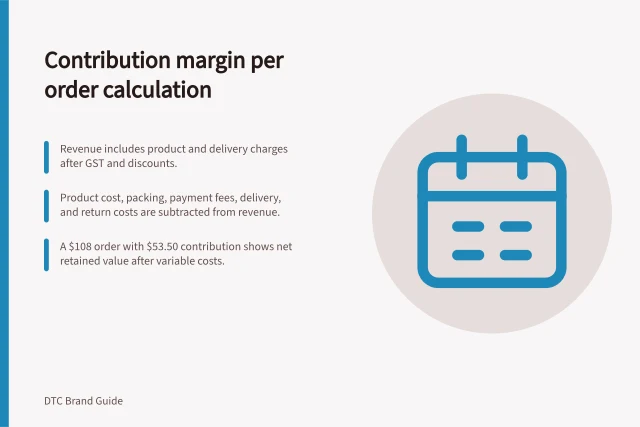
Group orders where the economics differ: full-price and discounted, first-time and returning, product or variant, channel, and delivery destination. Compare retained revenue with the costs of product, payment, packing, delivery, support and returns on a consistent basis. Reduce revenue for a refund once; count additional return freight or handling separately, without deducting the refunded amount again.
Ask whether the mix of orders changed or the cost of serving similar orders changed. More discounted single-item orders can reduce contribution even as order count rises. The same basket can contribute less when product or carrier charges increase. Check orders and invoices before assigning a cause.
| Pattern | Question to investigate | Response to assess |
|---|---|---|
| Growth comes mainly from discounted orders | Did retained contribution per order fall? | Revise the offer or its audience |
| Order contribution holds but profit falls | Which operating costs increased? | Reassess the new commitment against expected volume |
| Returns appear after a strong sales period | Which original orders and product versions were affected? | Investigate the item or customer expectation |
| Acquisition spend rises faster than retained first orders | Which costs and customers were counted? | Reconsider the spending rule or route |
These are diagnostic paths, not findings about a business.
Keep cash pressure separate
A payment for a larger stock order can strain cash before all its goods are sold. Its effect on the period's reported profit depends on the business's accounting treatment and the goods' status. Review the cash forecast alongside the reconciled profit and loss statement so the two questions stay clear.
Choose an action when the evidence points to a plausible cause and a result the team can check. For example, compare carrier invoices with the delivery allowance for the orders that grew, or inspect returns for the affected product version. Record the proposed change and review period. If the cause remains unresolved, delay a further scaling commitment rather than assuming additional revenue will restore profit.