Launch Operations
Part of DTC fulfilment decisions
Choosing self-fulfilment for an early-stage brand: a guide
Decide whether to pack DTC orders in-house using dispatch capacity, stock accuracy, handling rules, full costs and clear review triggers.
Decide whether to self-fulfil by testing whether your people, space and repeatable process can pack the actual order mix within the dispatch time you promise. Compare the full cost with a partner quote, then keep the model that works without routine overtime or fulfilment crowding out customer support.
Check capacity against the promise
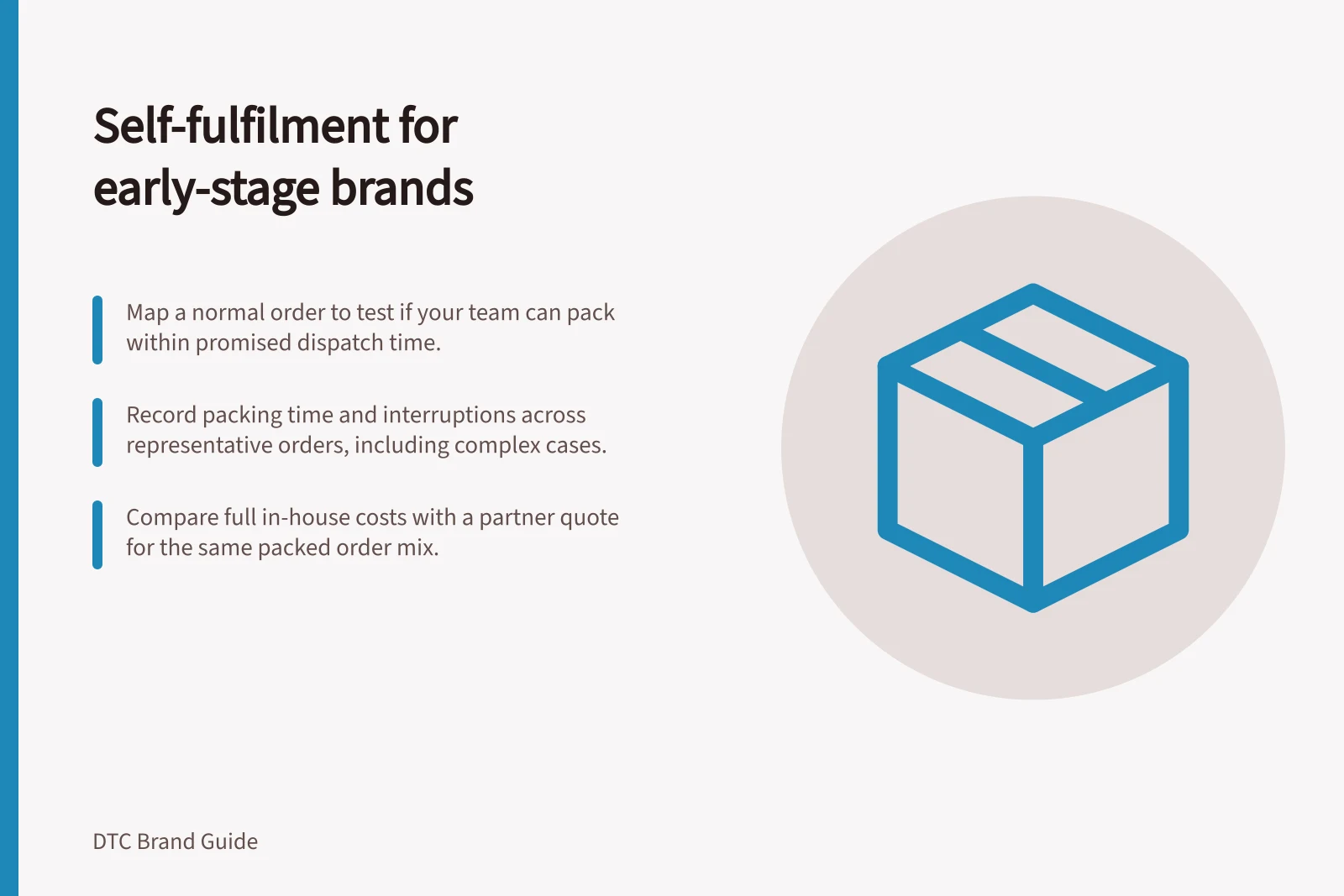
Map a normal order: confirm stock, pick, inspect, pack, label, hand over to the carrier and notify the customer. Add awkward cases such as a wrong address, damaged unit, multi-item bundle or return, and identify who covers the work when the usual packer is unavailable.
Record packing time and interruptions across representative orders, including complex ones, before setting a dispatch promise. Check the latest practical carrier handover. If meeting the cut-off routinely depends on unplanned evening work, change the promise or process, or reconsider self-fulfilment.
Make stock and packing repeatable
Give each sellable variant an identifier and storage location. Record sales, returns, damaged units and adjustments promptly, and distinguish stock available for sale from units already committed or damaged. business.gov.au recommends recording each sale and return and reviewing and updating inventory regularly; good records can help meet tax obligations and make end-of-year reporting easier.
Choose a stock-tracking method the team can keep current: business.gov.au describes periodic records updated manually, such as a spreadsheet or paper records, and perpetual systems that update through software or a point-of-sale system. List products or materials with details such as product name or code, quantity, cost and selling price.
Write a packing instruction for each product family. Specify the item and variant, inspection point, materials, contents and finished parcel dimensions, with a route for packages that do not fit the standard method.
Australia Post’s packaging tips say an item should fit without being too loose or too tight; packaging should be durable and secured with heavy-duty packing tape. For fragile or restricted goods, check the chosen carrier’s current rules.
Check the order, item, quantity, address and label before handover. Record errors and correct the instruction or process that allowed them; a printed label does not show that the carrier has the parcel.
Compare the full cost
For the same representative orders, count packaging, storage, equipment, carrier charges, staff or founder time, packing errors and returns. Use the time actually spent, and separate setup expenses from costs that rise with each order.
Compare the in-house total with a partner quote for the same packed order mix, checking which costs each figure includes. Measure and weigh the finished parcel, and request a quote for the packed item rather than estimating from the product alone.
Self-fulfilment is the stronger choice when its full cost is workable and the team can meet the dispatch promise reliably. If capacity is unreliable or a like-for-like partner quote compares favourably, reconsider the model.
Decide when to review the model
Track missed cut-offs, stock discrepancies, packing errors, absence cover and time spent on fulfilment. Review the model when problems recur or fulfilment starts crowding out customer support.
Use the promised dispatch time and recorded packing capacity as practical checks: if the team cannot complete the order mix and reach carrier handover reliably, change the process or promise, or compare self-fulfilment with outsourcing again. Set a review point before these problems become routine.