Growth Decisions
DTC wholesale and retail expansion
Plan wholesale expansion for an Australian DTC brand by checking customer fit, contribution, retail readiness and the commitments of running both channels.
Wholesale can put a direct brand in front of shoppers who may not visit its own store. It also commits the brand to supplying another seller on agreed terms, often before shopper demand is known.
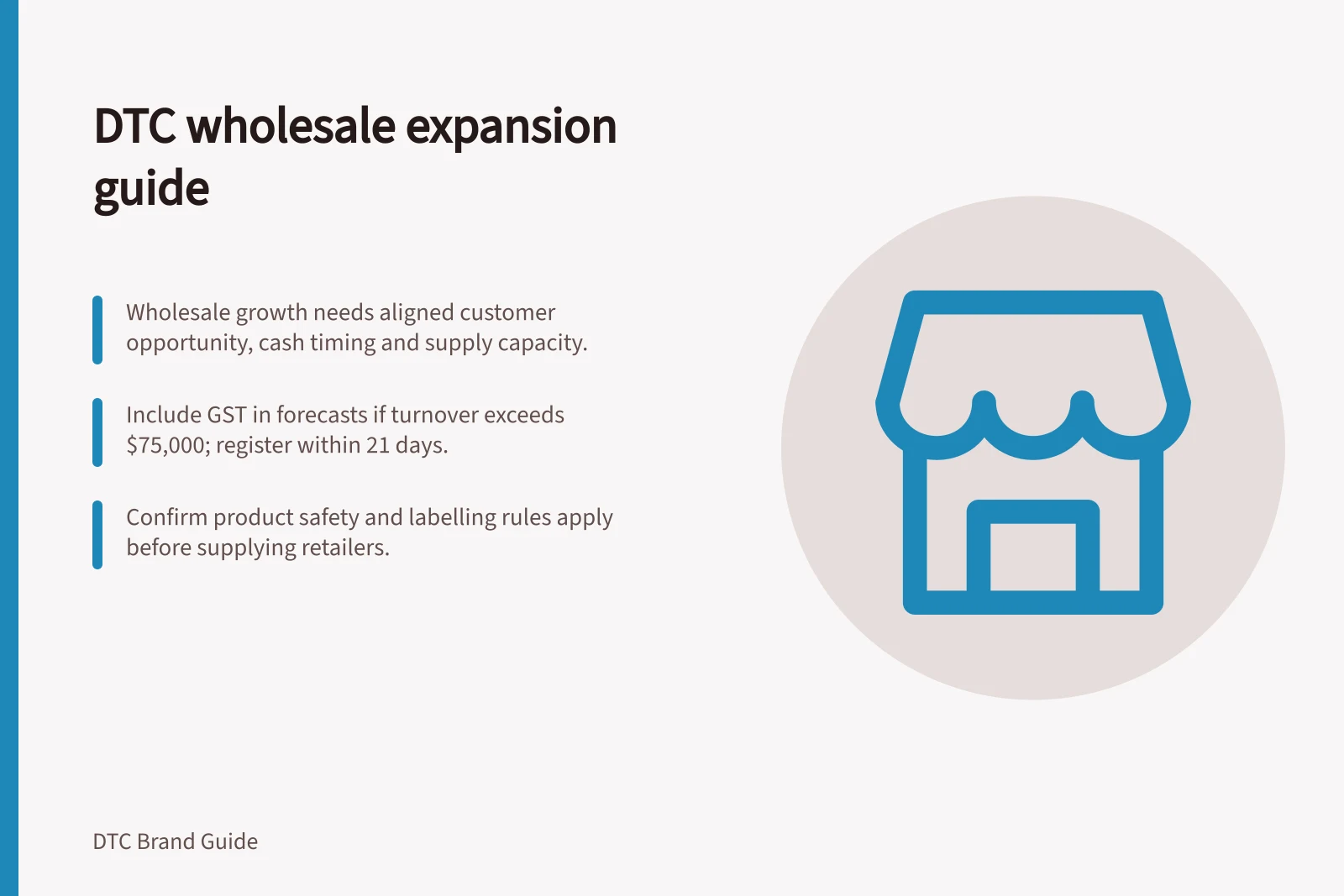
Expand when the customer opportunity, contribution, cash timing and supply capacity work together. A purchase order alone does not prove profitable growth.
Decide what retail should achieve
Name the shopper and purchase occasion a proposed stockist could serve. Would seeing, handling or buying the product in that setting help someone choose it?
Ask where the item would appear, what shoppers would compare it with and how its important limits would be explained. Confirm those details with each retailer rather than assuming every store works alike.
Set a goal for the first account, such as reaching a particular location or learning whether shoppers reorder an item after an initial placement. Decide what information the retailer can share. Its willingness to buy stock shows buyer interest; it does not establish sales to shoppers.
Check contribution and cash timing
Assess whether the proposed wholesale price can support the business after account costs. Wholesale gross margin and DTC contribution are different measures.
Read the terms behind the price: minimum order, payment date, freight responsibility, damage claims, returns and promotional support. Forecast when stock and delivery costs must be paid and when the retailer is expected to pay.
Check a slow reorder and the possibility that some retail purchases replace direct purchases. The separate contribution comparison covers the calculation in detail.
Keep GST and turnover visible
Include GST in the cash forecast when the business is registered. GST is 10% on most goods and services sold or consumed in Australia; registered businesses generally collect it from customers and pay it to the ATO when due.
Track GST turnover separately from profit. A business must register if its GST turnover is $75,000 or more; turnover is business income, excluding certain sales, not profit.
If you become aware your turnover will exceed the threshold, register within 21 days. Check monthly whether you are likely to cross it.
If you register, even when turnover is below the threshold, you must include GST in the price of most goods and services, claim GST credits for most business purchases and lodge activity statements. Factor those obligations into account pricing and administration before taking on more retail work.
Australian GST thresholds and obligations for DTC brands
- GST registration threshold
- $75,000 per year (GST turnover)
- Post-registration obligations
- Collect GST from customers, claim credits on business purchases, lodge BAS statements
Prepare the exact item for another seller
Give the buyer a current record for each sellable version: name and variant, contents, dimensions, case quantity, packaging, handling needs, images and supported customer claims. Confirm the buyer's required identifiers and data format; retailer requirements vary.
Check the exact goods against applicable Australian product safety and information rules before supply. Mandatory standards apply to certain products and may address safety or information.
Examples of mandatory information standards include ingredient labelling for cosmetics and care labelling for clothing and textiles. Retailer acceptance is not a compliance assessment.
Make sure the buyer's images and claims describe the version it will receive.
Launch an account the brand can serve
Agree who issues and confirms the purchase order, allocates stock, receives goods, reports shortages and handles product issues. Reserve units for accepted orders so the direct store does not promise the same stock.
Check any new case pack or label against the approved item before supply.
Set a review date for a bounded first account. Compare delivery and order records with the measures the retailer can provide, such as reorders or shopper sales. Use the review to identify operational changes needed before expanding to another account.
Keep account terms clear about consumer rights
Distinguish agreed retailer processes for reporting shortages or damage from consumers' rights when goods are faulty or incorrect. Under the Australian Consumer Law, consumer guarantees are separate from warranties and cannot be taken away by anything a business says or does.
On 16 April 2025, the ACCC accepted a court-enforceable undertaking from Hard Rock Enterprises Pty Ltd. The business admitted making misleading representations about consumers' rights, including displaying time limits for reporting faulty or incorrect goods.
Avoid copying short notification windows into consumer-facing information as if they limit those rights.
Manage both channels after launch
Keep product facts consistent and explain real differences between channel offers. A direct-only bundle or service can give the brand's store a distinct role if shoppers can see what is included.
Plan promotions with the stockist, while allowing it to make its own resale-pricing decisions. Australian competition law generally prohibits suppliers from imposing minimum resale prices; a recommended price must remain a recommendation.
Review stockouts, customer questions, retail reorders, direct contribution and the work each account creates. Add another account only when its proposed terms and the capacity to serve it have been checked.
If a channel issue raises a possible competition-law concern, the ACCC accepts reports and investigates behaviour that may be illegal. It does not intervene directly in disputes between businesses or provide legal advice, so use the appropriate route for a contractual dispute.
In this guide
- Assessing whether wholesale fits a direct brandScreen customer, product, supply and business fit before an Australian DTC brand commits to its first wholesale account.
- Comparing wholesale margin with DTC contributionCompare wholesale and DTC contribution for the same item with consistent GST treatment, channel costs, displaced sales and payment timing.
- Preparing product and brand information for retail buyersPrepare a concise retail buyer case, accurate item records and a controlled product-data handover for an Australian DTC brand.
- Avoiding channel conflict after a wholesale launchManage product information, stock, promotions and customer issues across a DTC store and Australian retail stockists after launch.