Unit Economics
Part of DTC wholesale and retail expansion
Comparing wholesale margin with DTC contribution
Compare wholesale and DTC contribution for the same item with consistent GST treatment, channel costs, displaced sales and payment timing.
Compare the contribution the brand retains from the same item in each channel after that channel's relevant costs. Wholesale gross margin, which stops at product cost, is not comparable with a DTC figure that includes packing, delivery and acquisition. Put both channels on a per-unit contribution basis, then check displaced direct sales and cash timing.
Use one consistent basis
Choose one SKU and one sellable unit. Use revenue and costs on a consistent GST basis that matches the business's records. For a GST-registered business, GST collected on taxable sales is paid to the Australian Taxation Office, while credits may be available for eligible purchases.
Confirm the treatment used in the accounts. Divide case-level wholesale amounts by the number of units, but keep the full case payment and stock commitment visible in the cash forecast.
For DTC, choose a representative order containing the item. State how shared parcel, payment and acquisition costs are allocated if customers often buy several units. Do not assign a single-item delivery charge to one channel and a shared two-item charge to the other without explaining the difference.
Build the contribution lines
Direct sale of one unit / Wholesale sale of one unit
- Retained product and delivery revenue
- Retained invoice revenue after applicable agreed deductions
- Less product and relevant inbound cost
- Less the same product and inbound cost
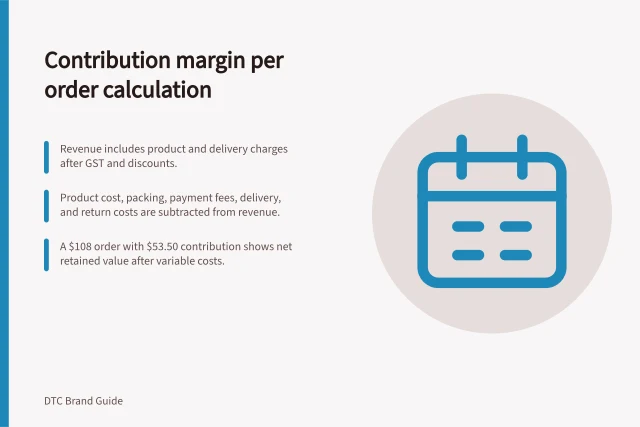
- Less attributable payment, packing, carrier, support and expected return costs
- Less attributable retailer-order handling, freight, expected claims and account service
- Show acquisition cost separately for an acquired customer's order
- Show account acquisition or servicing cost separately where relevant
Wholesale gross margin is retained wholesale revenue less product cost. Wholesale contribution also deducts the other wholesale costs listed above. Use contribution for the channel decision.
Keep fixed overhead outside both unit lines, or show a consistent stated allocation separately. If revenue has already been reduced by an expected refund, do not subtract that refund again as a return cost; include only additional return costs not already counted.
Work an illustrative example
Suppose one invented item sells direct for $100 and wholesale for $55. All amounts are assumed to exclude any applicable GST. Product and inbound cost is $35 per unit. For a representative first DTC order, allocated payment and packing cost is $5, delivery $10, expected return handling $3 and attributable acquisition $7. Contribution after these costs is $40: $100 − $35 − $5 − $10 − $3 − $7.
For the invented wholesale order, allocated freight and handling is $3, account service $2 and an agreed allowance $1 per unit. Contribution is $14: $55 − $35 − $3 − $2 − $1. Before those other wholesale costs, its gross margin is $20 per unit.
These figures show arithmetic only; they are not Australian benchmarks or business profit. A returning DTC customer's order would need its own acquisition-cost treatment.
A lower wholesale contribution does not automatically rule out the account. It may reach different shoppers or allow a different order scale. Equally, some retail purchases may replace direct purchases. Estimate a plausible range of displaced DTC units rather than counting every retail sale as new demand.
Test the written terms and cash
Model minimum and reorder quantities, payment date, freight responsibility, damages, returns, promotions and display support from the proposed agreement. Check when the brand pays for stock and shipping against when it expects payment. Run a cautious case with slow reorders and another with higher applicable deductions or handling costs.
Mark every input as quoted, contracted, observed or assumed. Recalculate when terms or the product change. The decision is the minimum arrangement that works for this SKU and this business, not a universal wholesale discount.