Launch Operations
Part of DTC fulfilment decisions
Evaluating a fulfilment partner from the promised customer experience
Assess a fulfilment partner using dispatch promises, packing rules, tracking events, exception ownership and complete operating costs.
Start with what customers have been promised, then ask a prospective fulfilment partner to show how it would support each part. The brand needs accurate order information, useful tracking and a way to resolve problems even when another business stores and dispatches its stock.
Turn the promise into requirements
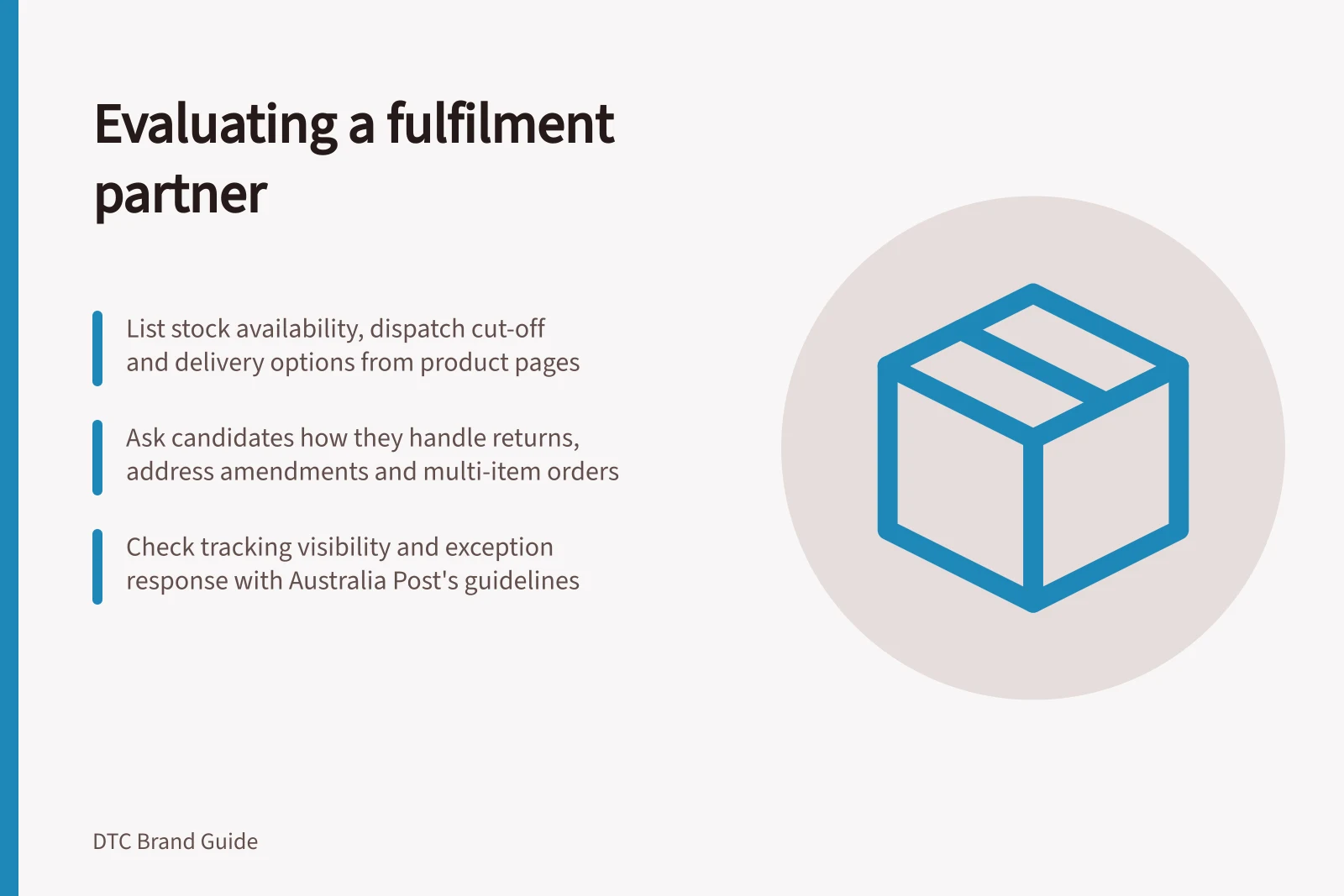
List the statements on product pages and at checkout: stock availability, dispatch cut-off, delivery options, packaging, tracking and returns. Mark which steps the partner controls and which depend on the store or carrier. Keep dispatch and arrival separate when setting targets.
Give candidates the same scenarios: a standard order, multi-item order, product needing careful handling, address amendment and return. Ask how each would be processed, what data the brand would receive, who would act on an exception and what charges would apply. These are proposed evaluation cases, not tests already performed.
Ask for evidence at each handover
| Customer expectation | Ask the partner to show | Decision point |
|---|---|---|
| Correct items arrive | Variant identification, picking checks and error records | Can the process handle the actual range and bundles? |
| Order leaves when promised | Cutoff, stock-receipt timing and carrier handover evidence | Is the dispatch claim supportable on busy days? |
| Parcel is protected | Product-specific packing rules and substitution controls | Who approves a change of box or cushioning? |
| Customer can follow progress | Order, label and carrier events visible to the brand | Can support distinguish preparation from transit? |
| Problems receive an answer | Alerts, enquiry ownership and return records | Who contacts the customer with verified information? |
Australia Post says an accurate email address and mobile number is important to match parcels to the receiver, and offers a tracking notification guide. Ask candidates how their integrations handle carrier tracking events, what each status actually tells the customer, and how the brand is kept informed when a delivery status changes.
Compare complete terms
Request written quotes for the same products, destinations and order mix. Ask about storage, inbound stock, picking, extra items, special packing, carriers, returns, minimum charges and changes to the account. Check charges for held, cancelled and split orders. Compare the total with the full in-house cost, rather than a headline pick fee.
Review the service terms before relying on a cut-off or delivery option. Australian government shipping guidance recommends checking parcel limits, timeframes, pick-up arrangements, compensation terms and integrations when choosing a delivery service. A fulfilment partner may use several carriers; establish who selects the service and how the brand learns of changes.
Key Australian Shipping & Compliance Guidelines
- Australia Post Tracking Notification Guide
- Available at https://auspost.com.au/business/grow-your-business/customer-delivery-experience/tracking-notifications
- Business.gov.au Parcel Limits & Timeframes
- Guidance available at https://business.gov.au/products-and-services/shipping
- ACCC Rules on Misleading Claims
- Enforced under Australian Consumer Law (ACL)
Set criteria for an acceptance check
If a candidate remains suitable, agree on a limited trial covering item accuracy, packing compliance, event visibility, exception response and invoice accuracy. Inspect actual outputs and customer-facing messages before moving the full order flow. No trial result is assumed here.
Put ownership of stock records, packaging changes, carrier enquiries, customer remedies and data export in writing. Choose only after the partner has demonstrated a process that fits the promise and the brand understands its limits.