Product Assortment
Part of DTC product assortment
Removing products that add complexity without value
Review difficult products for customer value and operating work, then simplify or retire them while accounting for existing orders.
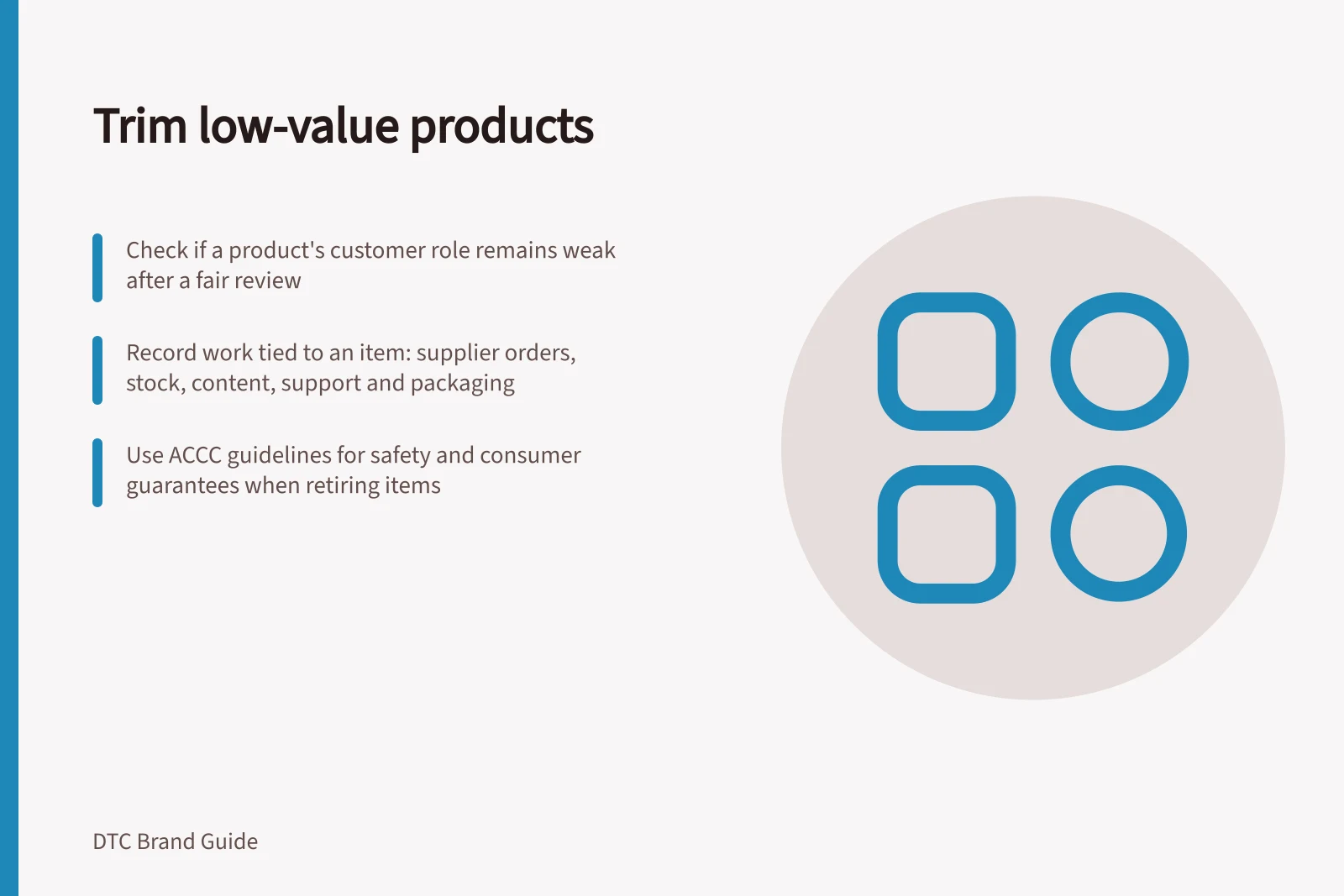
Consider removing a product when its customer role remains weak after a fair review and its stock, content or handling work is no longer justified. Check the need it serves for existing customers before retiring it. Slow sales justify investigation, not removal on their own.
Identify the work attached to the item
List what the item or variant needs: a supplier order, stock location, product page, instruction, package, compatibility check or support answer. Record errors and delays that can reasonably be traced to it. Use a defined review period and note when the item was unavailable, because a stockout or unclear listing can distort the sales picture.
Check value beyond sales rank
A replacement component may sell rarely but still matter to owners of the main product. A size option may serve a small group unable to use the standard size. Conversely, a steady-selling variant may split demand between similar choices while adding picking and stock work.
Make a short decision record:
Question / Evidence to inspect
- What need does it serve?
- Customer questions, purchase context and use.
- What happens without it?
- Suitable alternatives and needs left unmet.
- What does it contribute?
- Relevant order revenue and costs, including returns.
- What work does it create?
- Supplier, stock, content, packing and support records.
- Who relies on it already?
- Open orders, compatible products and existing owners.
The last question may change how the item is retired, even if it should no longer be promoted to new buyers.
Before and after: evaluating a product’s value vs. operational burden
- Customer need served
- High (e.g., niche size option for users unable to use standard sizes)
- Operational work created
- Moderate to high (supplier order, unique packaging, support queries)
- Impact if removed
- Unmet need for a small but loyal group; potential complaints or returns
- Revenue contribution
- Low (rarely sold)
Choose the action
The choice is broader than keep or delete. Correct a confusing listing, combine variants where the resulting offer remains accurate, reduce replenishment, change where an item is offered or plan its retirement. Record the reason and the evidence that would prompt a different decision.
Treat a possible safety issue separately and promptly. If an item may be unsafe or subject to a mandatory standard or recall, follow the applicable product safety process; the ACCC educates businesses about product safety responsibilities. Before discontinuing a line, consider your obligations to customers; the ACCC educates businesses about their obligations under the consumer guarantees.
Pros and cons of retiring a low-performing product variant
- ProsReduces stockholding, simplifies picking, lowers support load, frees up space for higher-value items
- ConsMay leave existing customers without a needed option; risk of negative feedback or compliance issues if not handled properly
Retire it cleanly
Before stopping sales, reconcile stock with open orders and bundles. Update listings, variant choices and stock records so the store does not promise a discontinued component. Check whether existing owners need care information, a compatible alternative or help with an earlier order. Do not describe a similar-looking item as compatible without a basis for doing so.
Decide separately what to do with remaining stock. Suitable stock might be sold at a lower price, but take care that the advertised price is clear and not misleading. Damaged, expired or unsafe units require an appropriate decision for their condition.
After the change, review relevant questions, returns and unmet needs. A shorter catalogue is useful only if customers can still make the purchases and obtain the support they reasonably need.