Unit Economics
Part of DTC pricing and promotional strategy
Comparing free delivery with percentage discounts by basket
Free delivery and a percentage discount can have the same headline appeal but different cost by basket, destination and product margin.
Free delivery and a percentage discount can share the same headline appeal, but their costs vary by basket, destination and product margin. Compare the cost on the same basket and zone, then check which offer performs better on completed orders and contribution.
Model the cost across baskets
For a simple offer-cost comparison, percentage-discount cost equals eligible merchandise value multiplied by the discount rate; free-delivery subsidy equals the delivery cost absorbed by the brand. Compare the offers on the same basket, destination and tax basis, and apply each cost to the same pre-offer contribution.
A fictional Australian-dollar management model leaves 40% of basket revenue before packing and delivery; packing is A$4, and delivery is A$8 metro, A$14 regional or A$25 remote. Its amounts exclude GST assumed recoverable, and the example does not determine any retailer’s GST entitlement.
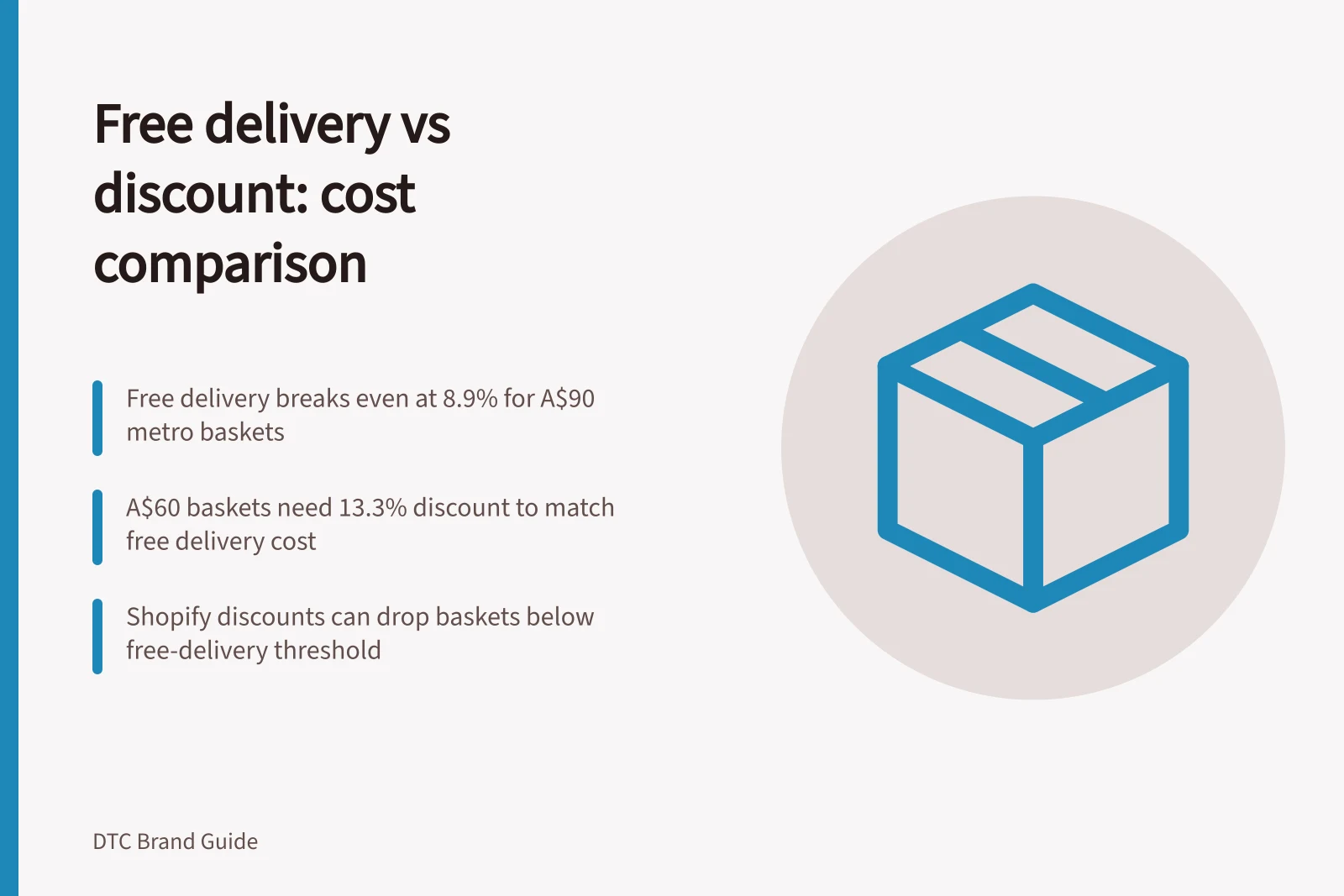
Assuming the discount applies to the full basket, the A$90 basket breaks even at 8.9% metro (A$8 ÷ A$90), 15.6% regional (A$14 ÷ A$90) and 27.8% remote (A$25 ÷ A$90). Below each rate, the percentage discount costs less; above it, absorbing delivery costs less.
For A$60 baskets, the corresponding break-even rates are 13.3%, 23.3% and 41.7%; for A$120 baskets, they are 6.7%, 11.7% and 20.8%, in metro, regional and remote zones respectively. The same delivery charge takes a smaller share of a larger basket.
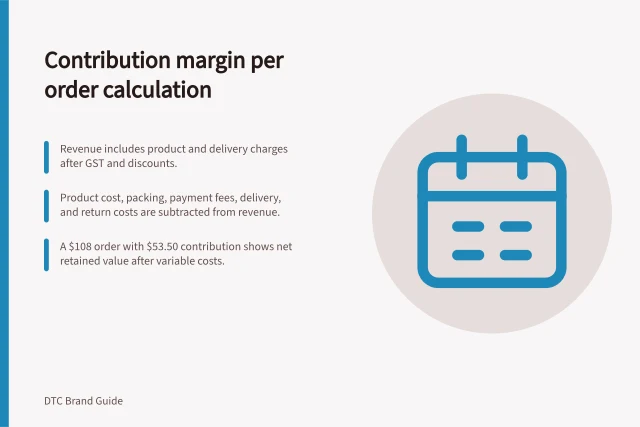
The A$90 basket contributes A$36 before packing and delivery. Free delivery leaves A$24 metro, A$18 regional or A$7 remote after packing and delivery, so only the metro basket meets the model’s chosen A$20 target, which is a planning assumption rather than a recommended margin.
Basket revenue alone can mislead: a separate A$120 basket with 25% contribution before packing and delivery contributes A$30, then A$12 after the model’s A$4 packing and A$14 regional delivery. A lower-margin basket can therefore leave less contribution despite its higher value.
The model’s revenue amounts exclude GST assumed recoverable, so they are not automatically GST-inclusive thresholds to display to customers. Convert to the appropriate customer-facing tax basis and retest actual qualifying baskets.
Easyship’s Australia-to-Australia calculator shows a 0.5 kg example quote of A$7.07 including GST for Aramex Domestic Cheapest, and A$11.10 for CouriersPlease. Use the rate for the actual parcel and route, and keep quote amounts on a consistent tax basis when comparing them with basket figures.
Test customer and business outcomes
Cost break-even does not show which offer customers prefer. Compare matched periods or groups while keeping other promotions stable, and track completed orders, basket mix, delivery cost, contribution, returns and customer complaints.
A higher conversion rate is not a win if fulfilment costs consume the gain. Compare contribution after each offer on matched baskets and destinations, not conversion alone.
Use the break-even rates as decision rules by basket and zone, and keep the offer conditions clear for customers.
Check how a free-delivery threshold is assessed after a percentage code. In a Shopify checkout example, a $49 basket fell to $44 after a percentage code and missed the free-shipping threshold, leaving delivery to be charged.
Voucherify supports order-percentage and free-shipping discount categories, optional validation rules and maximum limits for some discount types. Confirm that the conditions configured for an offer match the baskets and destinations you intend to include.
How to Evaluate Free Delivery vs. Percentage Discount Offers (Australian Retail Context)
- Define offer conditions clearly for customersEnsure free delivery thresholds and percentage discount applicability are unambiguous, especially when combined with other promotions.
- Test both offers in a controlled periodRun parallel tests with stable promotions; track completed orders, delivery costs, contribution, returns, and customer complaints.
- Measure contribution after fulfilmentDon’t rely on conversion rate alone—ensure the net contribution after packing and delivery meets target margins.
- Validate checkout logic (e.g., Shopify)Confirm that applying a percentage discount doesn’t cause a basket to fall below a free-delivery threshold.