Unit Economics
DTC operating dashboards
Build a DTC dashboard that connects orders, sellable stock, customer mix, returns and contribution to clear weekly decisions.
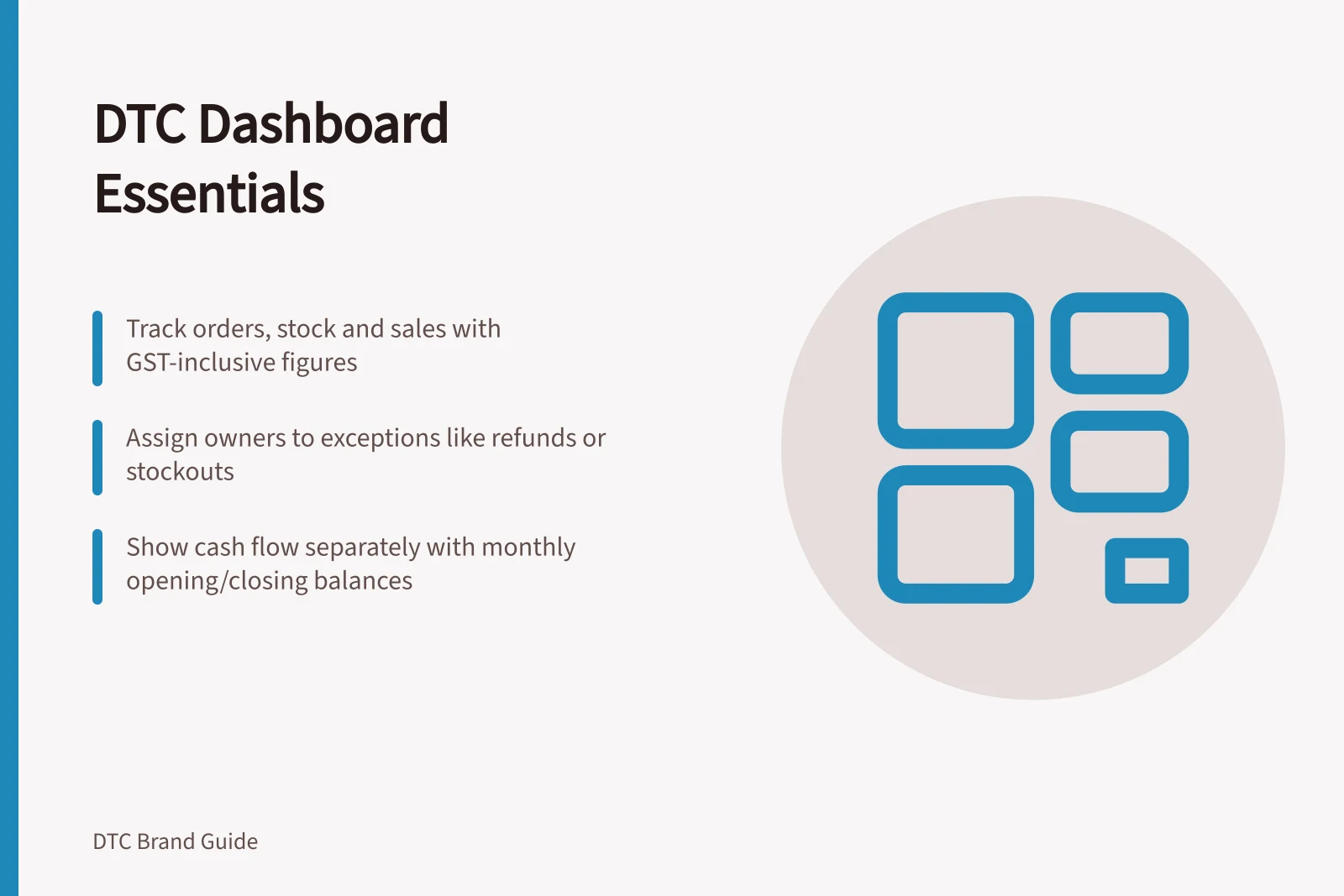
A DTC operating dashboard should help the team decide what needs attention this week. Bring orders, sellable stock, retained sales and order contribution into one view, then assign each important exception an owner. Totals alone cannot show whether a sales change reflects customer orders, unavailable stock, discounts or later reversals.
Start with the decisions
Write down the questions the team regularly needs to answer: which products may run short, which have had a fair chance to sell, whether orders contribute enough after their costs, and whether refunds change an earlier result. Choose measures that answer those questions, and keep detailed investigation in the underlying records.
| Decision area | Useful measure | Question it prompts |
|---|---|---|
| Orders | Orders and units by product, with availability noted | Could customers buy the item throughout the period? |
| Stock | Available units, commitments and confirmed incoming stock | What can be offered now? |
| Sales | Sales after discounts and reversals, on a stated GST basis | What amount remains under this reporting rule? |
| Economics | Product cost and relevant order costs shown separately | What did these orders contribute? |
| Customer mix | Revenue from first and later orders | Which orders came from new and existing buyers? |
| Exceptions | Refunds, returns and unresolved cases | Which figures or customer promises may change? |
Critical DTC Dashboard Measures by Decision Area
- Orders
- Units sold by product with availability status
- Stock Available
- Sellable units after commitments and incoming stock confirmed
- Net Sales (GST basis)
- Sales after discounts and reversals, reported on a stated GST basis
- Product Contribution
- Sales minus product cost and relevant order costs
- Customer Mix
- Revenue from first-time vs returning customers
Define each number
Specify the reporting period, time zone, currency, GST treatment, included channels and eligible order states. A weekly sales figure can show transactions processed that week or the eventual outcome of orders placed that week; decide which. Refunds can make those views differ.
Before treating a platform sales report as paid-order revenue or cash, check its definitions and filters against the underlying records.
For first-time and returning revenue, follow the separately defined customer-history procedure. Flag unmatched records rather than forcing them into a group.
For stock, define what is available to sell at the relevant location. Distinguish it from committed, unavailable or incoming units where the system supports those states, and check that inventory records are accurate.
Put related signals beside each other
Rising orders with little available stock call for a different investigation from falling orders despite continuous availability. High sales may need scrutiny if discounts, returns or fulfilment costs absorb much of the contribution. Show signals for the same product and period, then inspect the order and stock records before deciding why they changed.
A product gross-profit measure is not a complete operating result. Define which sales and product-cost fields it uses, and flag products or variants with missing cost data.
Payment, packing, delivery and return handling may require other records. State how shared order costs are allocated. Keep fixed commitments and cash timing in a separate view: positive product contribution does not establish that the next stock payment can be met.
Give cash its own view
A cash flow statement tracks money moving into and out of the business, not sales recorded by an operating dashboard. Use it to identify payment cycles and seasonal trends, forecast finances, and anticipate shortages or surpluses. Treat it as a companion view, not another sales total.
Lay out the cash view by month. Record the opening balance, cash incoming and cash outgoing; calculate the monthly cash balance by subtracting outgoing cash from incoming cash. The closing balance is the opening balance plus incoming cash, less outgoing cash. The next month's opening balance is the previous month's closing balance.
Classify cash by when it is received or paid. Cash incoming can include sales, debtor receipts, grants and tax rebates. Cash outgoing can include accountant fees, advertising and marketing, purchases, rent and rates, and utilities. This makes payment timing visible alongside the operating measures.
For a forecast, estimate future sales and costs, then consider when income is expected and when major costs will be paid. Previous years, seasonal trends and regular income can inform estimates of incoming cash; previous years, seasonal patterns and major costs can inform outgoing cash estimates.
Show actual and estimated figures distinctly. If a cost is estimated, label and explain it; state clearly whether figures include or exclude GST. These conventions help readers interpret the forecast and compare it with actual cash movements.
Show uncertainty and record the action
Mark missing product cost, uncertain customer matches, open returns and unconfirmed deliveries as data gaps rather than zeros. Note stockouts, promotions and product changes beside period comparisons. A short run of orders or a campaign can make last week's sales rate a poor replenishment estimate.
For each important exception, record the observation, what needs checking, the action, owner and review date. The next review should show whether the action happened and what changed.
In this guide
- Monitoring stock, margin and customer demand togetherCompare orders, sellable stock, returns and contribution for the same variant before reordering or changing an offer.
- Separating first-time and returning customer revenueClassify revenue by each order's customer history, handle later refunds consistently and keep customer counts separate.
- Tracking product-level profitability after returnsReconcile retained revenue, recovered stock value and order and return costs without counting a refund twice.
- Building a weekly trading review for a small DTC teamPrepare a short weekly trading pack, discuss material exceptions and leave with actions, owners and dates.