Unit Economics
Part of DTC unit economics
Setting an acquisition cost ceiling from product economics
Use first-order contribution and a chosen reserve to set a DTC acquisition cost ceiling, then check attribution and cash timing.
Set a customer acquisition cost ceiling from the contribution a new customer’s first order can provide. Reserve enough for the other costs and cash needs the business must meet. Treat later purchases as a separate case until comparable customer data supports them. The ceiling is a spending rule, not a forecast of campaign results.
Start with the likely first order
Select the offer new customers are expected to buy, including its discount and delivery terms. Subtract product, payment, packing, delivery, expected return and order-specific support costs from retained revenue. The result is first-order contribution before acquisition.
Use the expected mix of first orders, not only the best basket. A campaign that attracts discounted single-item orders cannot safely use a ceiling calculated from full-price bundles. When the mix is unknown, calculate several plausible cases and use a cautious one for the initial rule.
Choose what the first order must retain
Before fixed commitments and other cash requirements, first-order contribution is the break-even amount available for acquisition. Spending all of it leaves nothing from that purchase for those needs. Choose an explicit reserve:
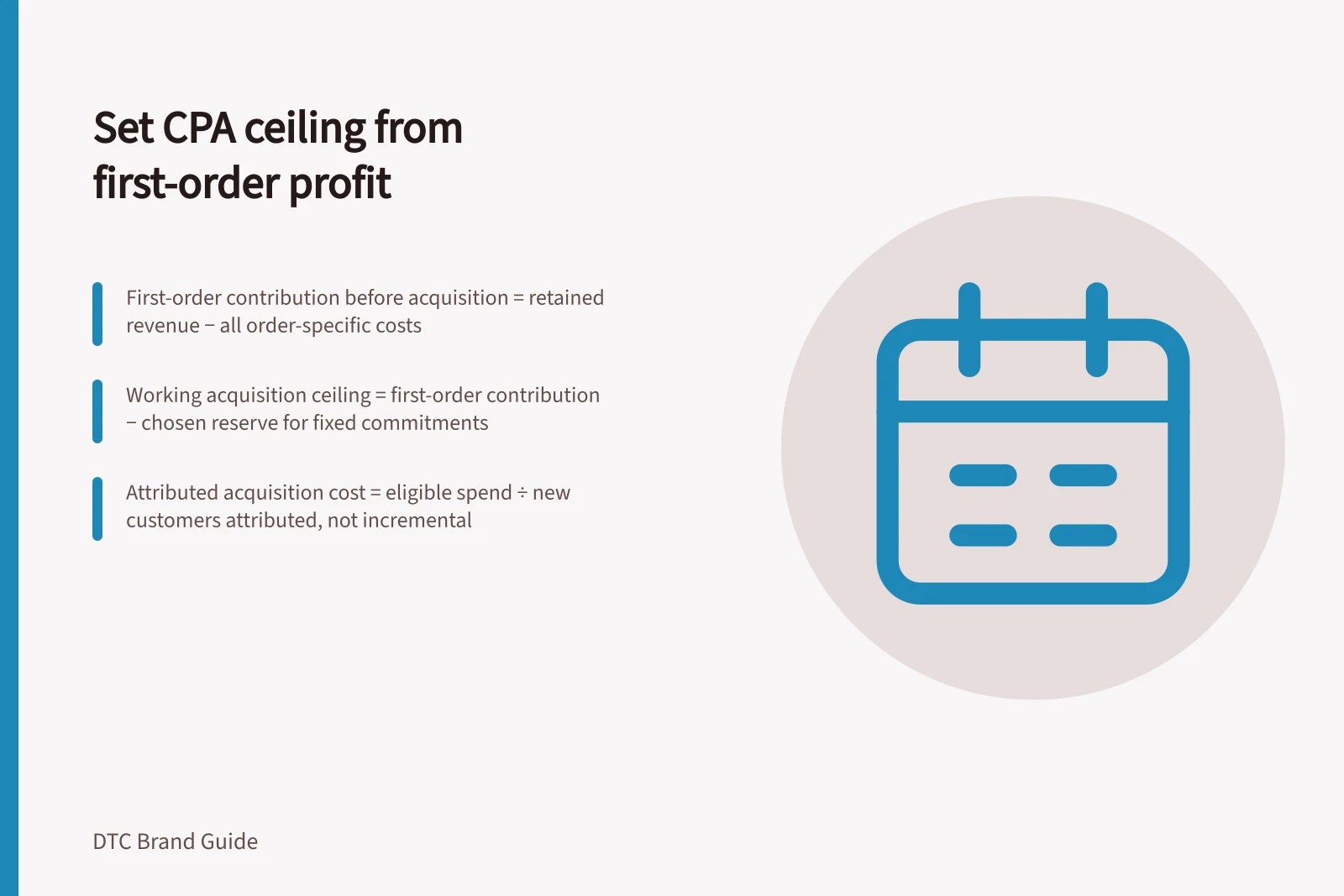
Working acquisition ceiling = first-order contribution before acquisition − required first-order reserve.
For any offer, the working ceiling is the first-order contribution before acquisition less the chosen reserve. If acquisition cost exceeds that ceiling, the first purchase falls short of the chosen rule. The figures a business uses are its own, not typical acquisition costs or a tested campaign. No universal reserve percentage applies.
The reserve should reflect what this business needs from the first purchase, including its fixed commitments and cash position. If the result is zero or negative, the first-order rule provides no positive acquisition budget at that reserve.
Key Metrics for Acquisition Cost Ceiling
- First-order contribution before acquisition
- Calculated from retained revenue minus order-specific costs
- Required first-order reserve
- Business-specific amount for fixed commitments and cash position
- Working acquisition ceiling
- First-order contribution before acquisition − required reserve
Compare like with like
Define a new customer and the spend period before calculating acquisition cost. Include relevant media, creative and agency costs; assign shared campaign costs using a stated method. Keep discounts in the order revenue calculation so they are not deducted a second time as acquisition spend.
Attributed acquisition cost is eligible spend divided by new customers attributed to the activity. It is not necessarily the cost of gaining an additional customer. Some attributed buyers may have purchased anyway, while tracking may miss or misassign others. A suitable comparison can help estimate incremental customers; until then, label the dashboard measure as attributed.
Check cash timing as well. Advertising and stock payments may be due before all related receipts arrive. A contribution ceiling can pass while a cash forecast shows a shortage.
Test the rule before raising spend
Check the ceiling for discounted orders, costly destinations, higher returns and the product mix the activity attracts. Recalculate when the offer or costs change. If observed acquisition cost exceeds the ceiling, investigate the order economics and measurement before increasing spend.
Measured repeat purchases may support a separate ceiling over a stated longer period. Keep the no-repeat case visible so forecast later revenue does not silently fund today’s acquisition decision.