Unit Economics
DTC unit economics
Understand DTC unit economics through order contribution, acquisition cost, repeat purchases, fixed costs and cash timing.
DTC unit economics show what an order contributes after the costs of making and serving it, how much that contribution can support customer acquisition, and whether the business can meet its wider costs and payments. Start with representative orders, then check discounts, delivery destinations, returns and repeat purchases separately. Product margin alone cannot answer those questions.
Follow the money through an order
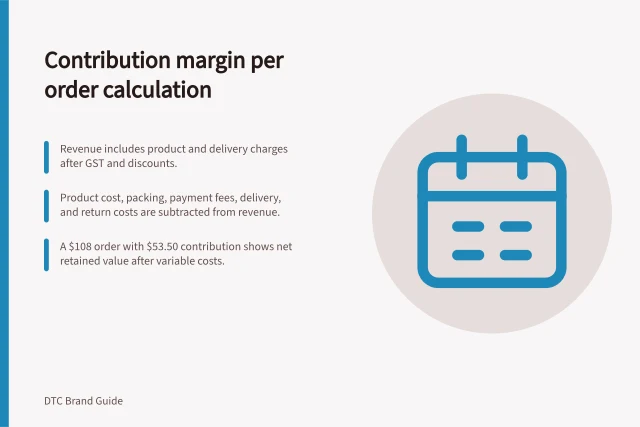
Assess the revenue an order retains and the costs of making and serving it. Consider product and delivery revenue, discounts, refunds, fulfilment and support, plus the possible effect of returns.
Order contribution before acquisition = retained order revenue − order-related costs. Keep acquisition spend in the next layer to see what the order itself contributes.
Keep the decisions separate
| Measure | Decision it helps with |
|---|---|
| Product margin | Does the selling price cover the product’s direct cost? |
| Order contribution before acquisition | What remains after serving this order? |
| First-order contribution after acquisition | What remains after winning this customer? |
| Customer contribution over a stated period | What have an original group’s orders contributed after their order costs and acquisition spend? |
| Business result and cash forecast | Can contribution cover fixed commitments, and can payments be met when due? |
A positive order contribution does not establish that rent, salaries, software and other fixed commitments are covered. Stock and advertising payments may also be due before later customer revenue arrives. Keep a cash forecast alongside the unit model.
Use estimated sales and costs for each future period, then compare projected balances with payments due.
Key Metrics in DTC Unit Economics
- Product marginDoes the selling price cover the product’s direct cost?
- Order contribution before acquisitionWhat remains after serving this order? (Retained revenue − order-related costs)
- First-order contribution after acquisitionWhat remains after winning this customer? (Includes acquisition cost)
- Customer contribution over a stated periodTotal contribution from an original group’s orders after order costs and acquisition spend
- Business result and cash forecastCan contribution cover fixed commitments and meet payments when due?
Use more than one order case
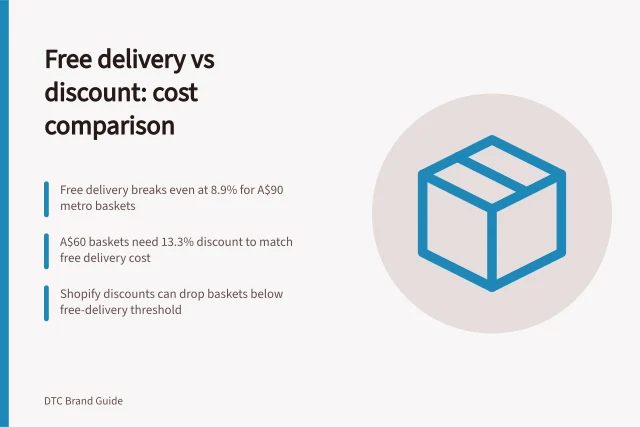
Calculate a full-price single-item order, a discounted order, a multi-item order and a costly delivery destination where relevant. Include the delivery amount the customer pays and the carrier charge. A bundle may share one parcel charge but need different packing or have a different return pattern.
Use supplier terms and carrier quotes until actual records are available. Mark estimates and their dates. Keep fixed charges separate from per-order charges; if you allocate a shared cost across orders for planning, show the allocation method.
For returns, distinguish refunded revenue from additional freight, handling, replacement dispatch and lost product value.
Critical Inputs for DTC Unit Economics
- Full-price single-item order
- Baseline for margin assessment
- Discounted order
- Assess impact of promotions on contribution
- Multi-item order
- Evaluate parcel size and packing costs
- Costly delivery destination
- Factor in carrier charges and customer-paid delivery fees
- Returns impact
- Refunded revenue + additional freight and handling
Decide what acquisition can cost
For a first purchase, order contribution before acquisition is the break-even acquisition amount for that order before fixed costs and other cash needs. A working ceiling is lower when the first order must leave money for those needs. Compare that ceiling with the cost of gaining additional customers. An advertising dashboard's attributed orders may include people who would have bought anyway.
State the customer definition, time period and costs included. If the spending rule depends on a later order, show what happens when that order never arrives.
Turn contribution into a cash-timing check
Order contribution describes the economics of an order; a cash flow forecast estimates sales and costs in future periods. Use it to check whether expected income can cover payments when they fall due, and to identify possible shortages or surpluses before they occur.
Set the opening balance for the first forecast month to the opening bank balance. For each following month, carry forward the previous month's closing balance. Record incoming and outgoing cash in the period you expect it to arrive or be paid, rather than treating every sale or cost as cash in the same month.
Cash incoming can include sales, debtor receipts, grants and tax rebates. Outgoing cash can include purchases, advertising and marketing, accountant fees, rent and rates, and utilities. Consider when major costs are paid, not just their amount, and use previous years' figures to account for seasonal trends where available.
Add the period's incoming cash and subtract outgoing cash to find its monthly cash balance. Add that balance to the opening balance to find the closing balance. Label and explain estimates clearly, and state whether forecast figures include or exclude GST.
Building a Cash Flow Forecast for DTC Businesses
- Start with opening bank balanceUse actual current balance as baseline
- Forecast incoming cashSales, debtor receipts, grants, tax rebates (include GST or exclude as appropriate)
- Forecast outgoing cashPurchases, advertising, rent, rates, utilities, accountant fees
- Record cash timing accuratelyMatch inflows and outflows to expected dates—not just calendar months
- Calculate monthly cash balanceIncoming − Outgoing = Net cash flow; add to prior closing balance
Treat repeat buying as evidence, not a promise
Repeat purchases may add contribution beyond the first order, but they are uncertain. Consider how product life, seasonality, availability and changes to the offer may affect whether past buying behaviour predicts future orders.
Use the model to find the cause of weak contribution: product cost, parcel size, delivery zone, discounts, returns or order mix. Recheck estimates against orders and invoices when they become available.
In this guide
- Calculating contribution margin per orderCalculate contribution per DTC order from retained revenue, product cost, payment, packing, delivery and returns, with a worked example.
- Setting an acquisition cost ceiling from product economicsUse first-order contribution and a chosen reserve to set a DTC acquisition cost ceiling, then check attribution and cash timing.
- Modelling repeat purchase without assuming it will happenBuild a repeat-purchase model from first-order cohorts, order contribution and a no-repeat case, with a hypothetical example.