Unit Economics
Part of DTC operating dashboards
Tracking product-level profitability after returns
Reconcile retained revenue, recovered stock value and order and return costs without counting a refund twice.
Assess a product after returns by combining retained item revenue, recovered stock value and the costs to serve and reverse the sale. A fully refunded item restored to sellable stock leaves a different operating result from one damaged with no recoverable value. Record the item's actual condition before assigning that value.
Choose the variant and outcome window
Identify the SKU or variant and the original orders included. For a recent period, show returns processed so far and mark outcomes still open. For a fuller assessment, follow those orders through a stated later date. Keep order and reversal dates visible: a refund this week may relate to an older order.
Shopify defines sales reversals as all order adjustments that result in negative monetary value. A monetary reversal alone does not establish that a unit physically came back into stock.
Reconstruct the operating result
For each affected order, record:
| Component | Treatment |
|---|---|
| Item sale and discount | Use the amount charged for the item on a consistent GST basis. |
| Refund or other reversal | Reduce retained revenue once and link it to the original item where possible. |
| Original item cost | Record the cost of the item supplied, including any consistently allocated inbound cost. |
| Recovered stock value | Add only the supported value of a returned item restored to usable stock; record any write-down. |
| Outbound costs | Include attributable payment, packing, dispatch and delivery costs incurred. |
| Additional return costs | Include applicable return freight, inspection, repacking, replacement dispatch or disposal. |
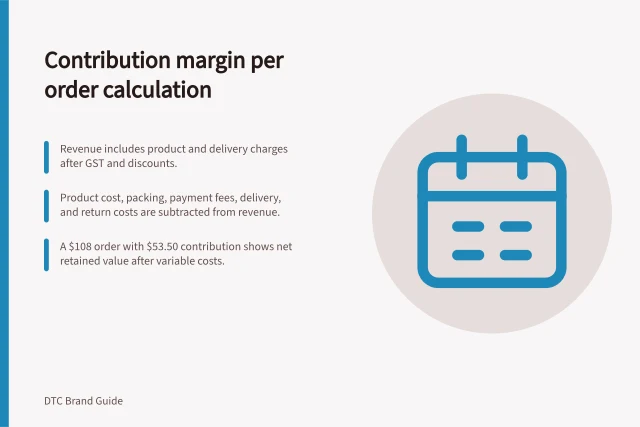
Working contribution after returns = retained item revenue − original item cost + recovered stock value − attributable outbound costs − additional return costs. Allocate shared charges by a stated rule. If delivery revenue is included, allocate it consistently too.
This is a management measure for the orders reviewed, not statutory profit or a substitute for the accounts. An item's recovered value must not be counted again as newly acquired stock when it is later resold.
Shopify defines gross profit as net sales less product cost and reports profit only for variants with product cost information recorded at the time of sale. Its sales-report terms define gross sales before shipping, so treat delivery amounts separately when constructing this measure.
Key Metrics for Tracking Product-Level Profitability After Returns
- Retained Item Revenue
- GST-exclusive amount charged at sale
- Original Item Cost
- Cost of goods supplied + allocated inbound costs
- Recovered Stock Value
- Only if restored to sellable stock; record write-downs
- Outbound Costs
- Packing, dispatch, delivery and payment fees
- Additional Return Costs
- Return freight, inspection, repackaging, disposal or replacement
Check the returned item's condition
Consider a hypothetical order on a consistent GST-exclusive basis. An $80 item with an original $30 cost is fully refunded. The business incurred $8 outbound fulfilment, a $3 payment charge and $7 return freight and inspection. If inspection supports restoring the item to sellable stock at its full $30 cost, retained revenue is zero and recovered stock value is $30.
Working contribution is negative $18: $0 − $30 + $30 − $8 − $3 − $7. If the item has no recoverable value, it is negative $48. The figures demonstrate the effect of condition; they are not typical costs or a prescribed accounting entry.
Do not subtract the $80 refund a second time as a return expense. Do not count an item as sellable merely because it is physically back. Reconcile the stock record with inspection and the accounting treatment used by the business.
Use the finding carefully
Compare variants over a window long enough for relevant returns to emerge. Show missing reasons and unresolved inspections. A high return count could reflect fit, description, defects or delivery damage; the financial row cannot establish the cause. Send that question to customer feedback and product investigation while each customer case continues to be handled on its own facts.